
Preventing Slips, Trips, and Falls: Hierarchy of Controls, Risk Assessment & Continuous Monitoring
May 5, 2023
Did you know fall protection has been OSHA’s most frequently cited safety and health standard for 13 consecutive years?
In 2023 alone, there were 7,271 violations.
These seemingly innocuous incidents can lead to serious injuries, impacting both the well-being of workers and the operational efficiency of organizations. To address this critical issue, organizations must adopt a proactive approach, leveraging strategies such as the Hierarchy of Controls and embracing continuous improvement methodologies.

What is the hierarchy of controls for slips, trips and falls prevention?
Understanding control and how to manage your walking working surfaces program is more important than the outputs of the risk assessment process. The process defines good control actions specific to hazards and risks, but it’s not the only option.
While I’m a firm believer in the risk matrix and scoring approach, I also recommend the widely accepted hierarchy of controls in safety and health practice. This process is simple to understand and useful in gauging the control appetite of the organization. It should serve as the overarching methodology for delivering the right level of program control within walking-working surfaces programs.
The control hierarchy places the most effective controls at the top: engineering solutions, followed by administrative controls, and finally reliance on personal protective equipment.
While not exhaustive, this list highlights key control considerations for improving the walking-working surfaces program.
| Hierarchy of Control | Control Feature | Examples of Control |
|---|---|---|
| Elimination | Completely eliminate the hazard. | Eliminate motorized and material handling equipment from the facility. |
| Substitution | Reduce a hazardous situation component, material and/or piece of equipment. | Install slip-resistant flooring. |
| Engineering Controls | Isolate people from the identified hazard or risk. | Improve illumination to the walking-working surface. |
| Administrative | These controls are changes that can include safety policies, rules, supervision, schedules and training. | Train workers on slips, trips and falls |
| PPE | Protection worn by a worker to protect them or reduce loss threshold from a hazard. | Require slip-resistant footwear. |
How does risk assessment help prevent falls on the same level?
Risk assessment helps prevent same-level falls by identifying hazards in the work environment, evaluating how people navigate walking-working surfaces, and creating controls proportional to the risk level. The goal is to build a credible, criteria-based understanding of what is acceptable and what is not.
Most regulatory bodies require some form of risk assessment, and most follow a similar template:
- Identify risks to the worker associated with work activity.
- Identify hazards found in the work environment that pose a threat of loss.
- Provide details of identified risks or hazards and provide context to build understanding.
- Utilize a measurement system to evaluate risk understanding and decide precautions.
- Build controls that protect people and the work environment.
To manage walking-working surface risks with control proportional to the threat, safety and health practitioners should consider a structured assessment process. The U.K.’s HSE developed a risk assessment process that supports this well. Widely adopted throughout Great Britain and the European Union, it addresses risk through hazard understanding, evaluation, and identifying who may be affected. It prioritizes risk by distinguishing that a hazard is anything with the potential to harm workers, while risk is the likelihood of harm from that hazard.
How do you use a risk matrix to evaluate walking-working surfaces?
A risk matrix evaluates walking-working surfaces by scoring each hazard on likelihood and severity. It then plots the result to determine if the risk is acceptable or requires control. If the activity rating rises above acceptable levels, controls are needed to bring the score back down to an acceptable range.
For every hazard identified during a walking-working surfaces inspection, ask: “What if?” What is the worst-case outcome: a fatality, significant injury or permanent disability, minor injury, or property/environmental damage? Using the risk matrix, you can judge the likelihood and severity of harm.
- Severity: The degree or amount of expected loss.
- Likelihood: How likely it is that the loss will occur.
- Risk rating: The probability and severity of the risk, before and after control actions are taken.
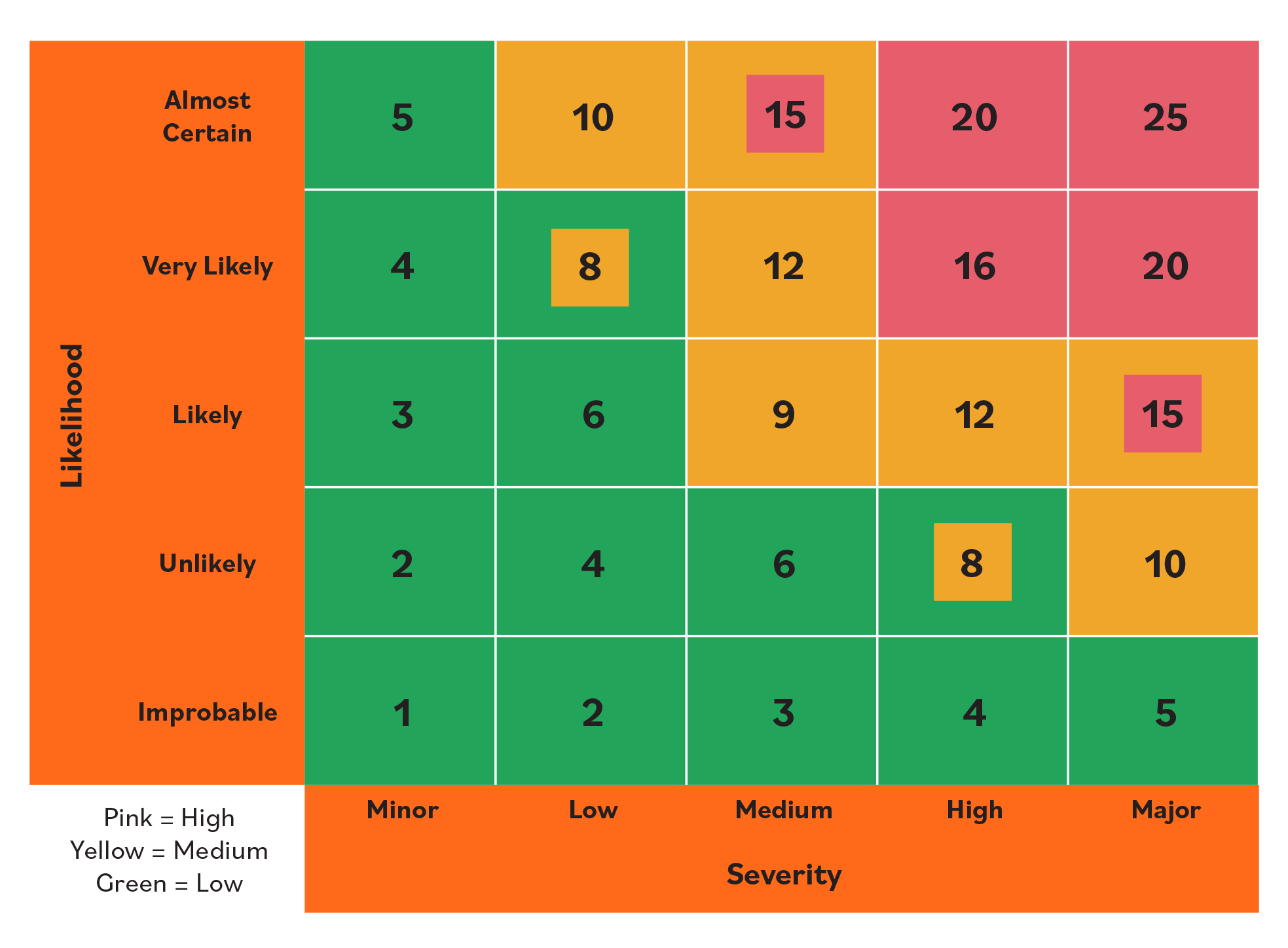
Using a five-point (5×5) matrix, you can estimate likelihood and severity across five descriptive levels each.
Likelihood Scale
| Rating Score | Qualitative Element | Definition |
|---|---|---|
| 0 | Impossible | No injury or illness, damage or other loss is possible. |
| 1 | Improbable | Loss, injury, or illness could only occur under freak conditions. The situation is very well managed, and all reasonable precautions have been taken. |
| 2 | Unlikely | The situation is generally well managed. However, occasional lapses could occur. This also applies to cases where people are required to behave safely to protect themselves but are well trained. |
| 3 | Likely | Insufficient or substandard controls in place. The loss is unlikely during normal operation. However, it may occur in emergencies or non-routine conditions. |
| 4 | Very likely | Serious failures in management controls. The effects of human behavior or other factors could cause an accident but are usually supported with this additional factor. (E.g., ladder not appropriately secured, oil spilled on the floor.) |
| 5 | Almost certain | Absence of management controls. If conditions remain unchanged, there is nearly 100% certainty that an accident will happen. (E.g., broken rung on a ladder, live exposed electrical conductor.) |
Severity Scale
| Rating Score | Qualitative Element | Definition |
|---|---|---|
| 0 | None | No injury or illness, damage or other loss is possible. |
| 1 | Minor | Minor injury, illness, or loss is possible. (E.g., light cuts, scratches, insignificant damage to property.) |
| 2 | Low | Significant injuries or illnesses are possible (e.g., sprains, bruises, events needing medical care.) Damage to property or process. |
| 3 | Medium | Temporary disability is possible. Lost workdays due to injury or illness. Substantial damage or loss of property or process. |
| 4 | High | Permanent disability is possible. |
| 5 | Major | Causing death to one or more people. Loss or damage is such that it could cause serious business disruption. |
Likelihood (probability) x Severity (consequence) = Risk
Practical example of the risk matrix
A worker is expected to walk into the work area to feed raw material and sometimes must cross the machine frame to reach the other side where other tasks are done. The worker steps onto a metal surface mostly covered with a loose rubber mat. Worker interviews indicate the mat is used because the surface becomes slippery, but the mat is in poor condition.
There are also two product roll stands 15″ (38cm) above the work surface — empty, with exposed sharp edges, due to the current machine setup. Workers frequently strike these stands, causing significant knee and shin injuries.
Before controls: Likelihood (4 — very likely) x Severity (4 — permanent disability possible) = Risk Rating 16 (High). This indicates the hazard requires controls to keep the work environment safe.
Controls applied:The leading edge was marked with a patterned contrasting color to show the elevation change. The frayed rubber mat was replaced with slip-resistant flooring firmly adhered to the metal surface. The roll stands were covered with a protective soft sleeve. We added additional signage and trained workers on the new color scheme and updated procedures.
After controls: Likelihood (2 — unlikely) × Severity (3 — temporary disability possible) = Risk Rating 6 (“Tolerable”).
The purpose of risk assessment and evaluation is to help prioritize which hazards and risks require action. In this scenario, the risk is now tolerable, with further reduction opportunities available if desired. These analytic tools are vital fall protection solutions for lessening and ultimately preventing falls on the same level.

How do you continuously monitor a slips, trips and falls program?
You continuously monitor a slips, trips, and falls program by applying Deming’s PDCA cycle for Plan, Do, Check and Act. This means regularly checking whether your control strategy eliminated the problem or reduced it to a tolerable level, rather than assuming the work is done once a project is executed.
Business theorist and management expert W. Edwards Deming recognized in the 1950s that work systems need a continuous feedback loop, so managers can identify and adjust the parts of a process that need improvement. He called this the PDCA cycle.
Many organizations have dealt with poorly executed projects that created loss potential, so regularly checking the process is necessary to maintain control. Continuously monitoring your walking-working surfaces program confirms whether you’ve gained control of issues raised during inspection and whether your control strategy eliminated the problem or reduced it to a tolerable risk level. The core questions to keep asking are: Did you achieve your goals, and can you sustain them?
For the safety and health practitioner, the reality is straightforward: unless you can genuinely say the deviation (issue) has been eliminated and can’t return, you’re never truly “done” looking for, evaluating, and controlling risk in the work system.
What EHS software supports slips, trips and falls prevention?
Four Intelex applications directly support a slips, trips, and falls prevention program: Risk Matrix Designer, Safety Inspection Software, Incident Management Software, and CAPA Software. Together, they turn the frameworks above — hierarchy of controls, risk assessment, and PDCA monitoring — into a sustainable, data-driven process.
- Risk Matrix Designer: Streamlines the risk assessment process with a centralized platform for creating, documenting, and managing risk matrices. Organizations can systematically evaluate risks tied to specific jobs or tasks, identify hazards that cause slips, trips, and falls, and implement control measures. It digitizes risk matrices, giving workers ready access to the information they need to work safely.
- Safety Inspection Software: Facilitates regular inspections of walking-working surfaces so organizations can identify and fix hazards before incidents occur. Through a mobile app, workers can conduct inspections efficiently, with findings documented and aggregated into insights that prompt corrective action.
- Incident Management Software: Enables swift reporting, investigation, and documentation when a slip, trip, or fall occurs. It helps identify root causes, analyze trends, and implement corrective actions, supporting a proactive approach to preventing recurrence.
- Corrective and Preventive Action (CAPA) Software: Helps organizations implement corrective and preventive measures based on incident analyses and risk assessments. Tracking corrective actions in a centralized system supports a continuous improvement loop aligned with the PDCA cycle Deming advocated.
FAQs: How to prevent slips, trips and falls
How often should a walking-working surfaces risk assessment be repeated?
A walking-working surfaces risk assessment should be repeated on a regular, defined schedule and immediately after any incident, near-miss, process change, or facility modification that could introduce new hazards. Risk levels can shift as equipment, layouts, or work practices change. A one-time assessment isn’t sufficient. Continuous monitoring through a PDCA-style feedback loop confirms controls are still working as intended.
What are the most common causes of same-level falls in the workplace?
Common causes of same-level falls include slippery or contaminated flooring, poorly marked elevation changes, cluttered walkways, inadequate lighting, and worn or damaged flooring materials. Many of these hazards are preventable through engineering and administrative controls such as slip-resistant flooring, improved illumination, and clear hazard signage identified through routine walking-working surface inspections.
What specific criteria or indicators are used to determine if a risk level is “tolerable”?
Tolerable risk is the level an organization can accept given the benefits of the activity generating it. Determining it typically involves both quantitative and qualitative measures. It reflects compliance with legal requirements and internal safety standards that incorporate industry best practices and benchmarks. Organizations combine incident data, historical benchmarks, regulatory thresholds, and stakeholder input including worker and management risk perceptions, and classify results within a risk assessment framework or matrix.
How does Intelex EHS Software integrate with other safety management systems and processes within an organization?
Intelex EHS Software integrates with other systems through APIs and data import/export functions designed for interoperability. Integration begins with a detailed analysis of existing systems to identify compatibility and integration points. The extent of integration depends on the technical specifications of those systems and the organization’s requirements. It typically requires collaboration between IT specialists, EHS professionals, and the software provider to ensure a seamless rollout.
What’s the difference between the hierarchy of controls and a risk matrix?
The hierarchy of controls and a risk matrix serve different but complementary purposes. The hierarchy of controls ranks types of solutions from most to least effective (elimination through PPE). A risk matrix quantifies a specific hazard’s likelihood and severity to determine how urgently it needs control. In practice, a risk matrix is often used first to prioritize a hazard, and the hierarchy of controls then guides which solution category to apply.
See Intelex in action
Preventing slips, trips, and falls comes down to three connected disciplines: applying the hierarchy of controls to choose the right type of solution, using risk assessment and a risk matrix to quantify and prioritize hazards, and sustaining those controls over time through continuous monitoring.
None of these works in isolation. A well-chosen control that’s never re-checked can degrade just as easily as a hazard that was never assessed in the first place.
As fall protection remains OSHA’s most-cited violation year after year, organizations that treat these frameworks as an ongoing discipline rather than a one-time compliance exercise will be the ones that meaningfully reduce risk and protect their workforce long term.
Ready to enhance your safety program and reduce workplace hazards? Book time with our team to see how Intelex’s EHS software can help you implement the Hierarchy of Controls for effective, continuous improvement.