

Work is Safer Than Ever. So Why Aren’t Fatalities Falling?
September 4, 2026
10 minute read
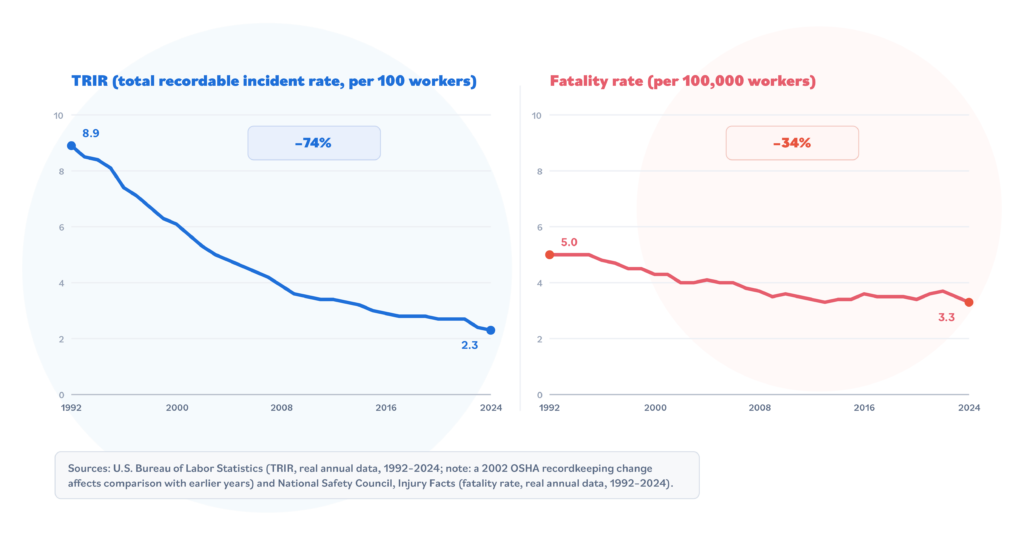
Over the past 50 years, the safety profession has achieved something remarkable. Total recordable incident rates have fallen by 74% from 1993 to 2024 (from 8.9 to 2.3 incidents per 100 full-time workers, according to Bureau of Labor Statistics data). Near-miss programs have expanded. Behavior-based safety has become standard practice. By most traditional measures, work is now meaningfully safer.
Bureau of Labor Statistics data shows the workplace fatality rate has made more modest gains — dropping 34% since 1993, and hovering between 3.3 and 3.6 per 100,000 workers since 2013.
The data points to an uncomfortable truth: While we’ve gotten very good at preventing the incidents that show up in injury reports, the ones that kill people follow different rules.
Key terms at a glance
- TRIR (total recordable incident rate): A standard safety metric counting all work-related injuries requiring medical treatment beyond first aid, per 100 full-time workers. Widely used but, as we’ll explore, a poor predictor of fatal risk.
- SIF (serious injury or fatality): Incidents that result in death or permanent disability, or have realistic potential to do so. Often referenced alongside “PSIF” (potential SIF) events, where the conditions for a fatality exist, but none have occurred.
- High-energy hazard: A hazard involving physical energy exceeding 1500 joules — the threshold above which an incident is most likely to cause a serious injury or death. In this context, “energy” means physical energy in any form: A falling worker, electrical contact, a vehicle in motion, and an arc flash are all high-energy events.
- Leading indicators: Metrics of conditions, actions, or system performance that precede or predict injury outcomes, enabling action before harm occurs.
- Lagging indicators: Metrics that measure outcomes after they occur: injuries, incidents, fatalities. Useful for reporting and learning, but limited use for prevention. TRIR and SIF are lagging indicators.
We’re optimizing for the wrong thing
The way the safety profession measures performance rests on an assumption that’s now decades old.
The Heinrich Pyramid, developed in 1931, proposed that workplace injuries follow a predictable ratio: For every major incident, there are 29 minor injuries, and for every minor injury, 300 near-misses. The implication was powerful and intuitive: Reduce the base of the pyramid, and you’ll reduce the top. By addressing near-misses, you’ll prevent fatalities.
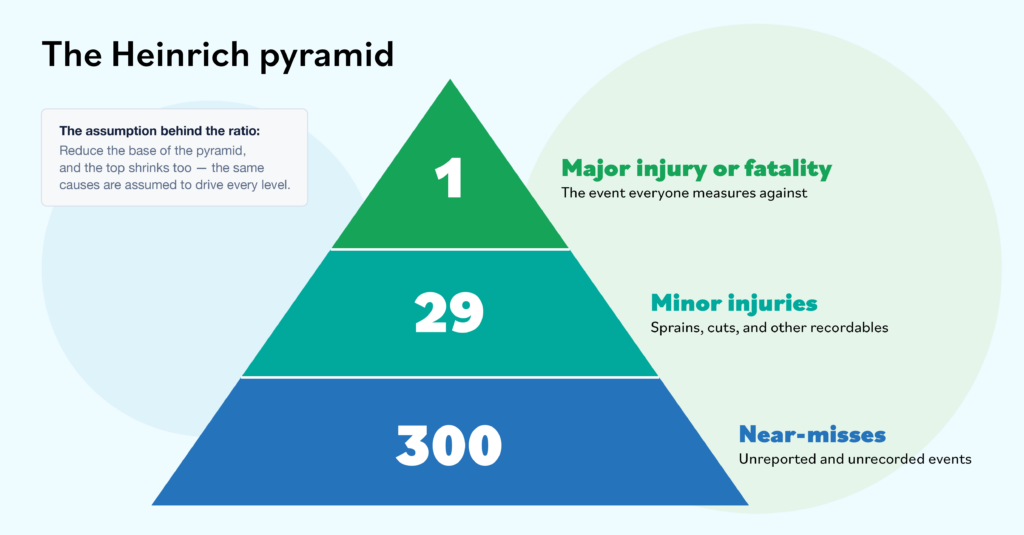
This model gave the industry its justification for using total recordable incident rate (TRIR) as the primary measure of safety performance. If the same underlying causes produce both a sprained wrist and a fatal fall, then driving down recordable injuries should drive down fatalities, too.
“What was frankly made up was the idea that the ratios are consistent,” Dr. Matthew Hallowell told us in a recent webinar. “If you want the most hardcore evidence that that is not a true statement, you can look at the graph, because if it were true, those two lines would have to track parallel and they certainly couldn’t cross.”
The Construction Safety Research Alliance (CSRA) examined 3.26 trillion worker-hours of data across industrial sectors. The finding was clear: “Trends in TRIR do not associate statistically with fatality occurrence. Instead, fatalities appear to follow different patterns, suggesting that they occur for different reasons.”
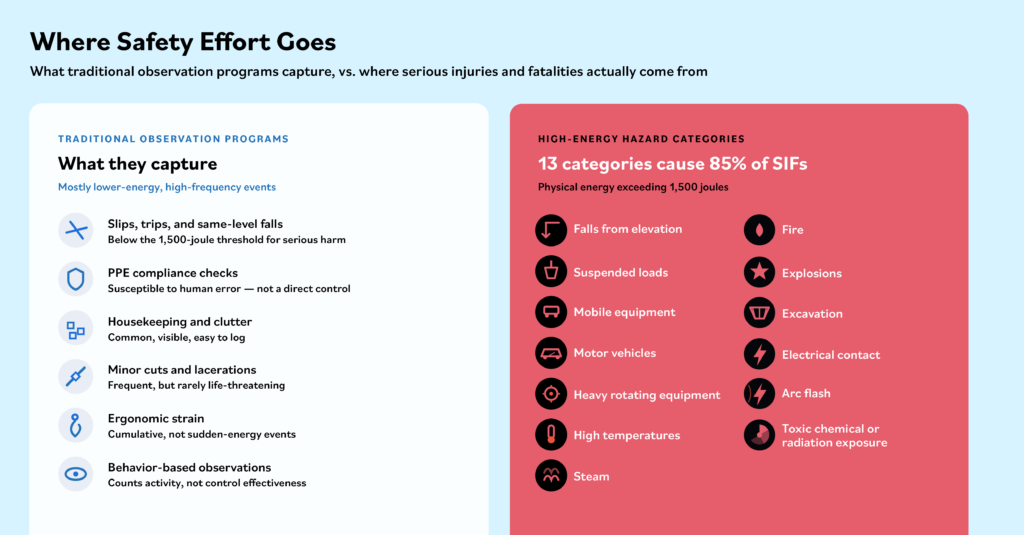
In other words, the hazards that hurt people are not the same as the hazards that kill people. Strains, sprains, lacerations, and minor falls make up the bulk of recordable workplace injuries. Behavior-based safety programs, observation rounds, and PPE compliance checks help prevent these lower-energy incidents. However, they’re far less effective against the high-energy exposures that cause fatalities — because those are a different problem, with different causes, requiring different controls.
The result is exactly what the data shows: decades of TRIR reduction — a genuine achievement — alongside a relatively flat fatality rate. The industry has gotten very good at preventing the incidents that TRIR captures. But as Dr. Hallowell and the CSRA confirm, reducing those incidents doesn’t move the needle on the ones that matter most.
The trouble with TRIR
Beyond its disconnect from fatalities, TRIR has an accuracy problem. According to CSRA research, accurately reporting TRIR to one decimal point requires approximately 300 million worker-hours of data. Almost no individual site, team, or company ever reaches that scale. This means that number your organization reports — and compares itself against — is, in most cases, not statistically meaningful.
“The timing of when and where the next recordable happens is about 98% random,” Dr. Hallowell told us. “Which is almost exactly the same level of randomness as the flip of a coin.”
When two companies report TRIRs of 1.4 and 0.8, the instinct is to read one as meaningfully safer than the other. But at typical worker-hour volumes, the margin of error around both numbers is so wide that you can’t draw a valid conclusion from the difference.The CSRA article puts this bluntly: “In nearly every practical circumstance, it is statistically invalid to use TRIR to compare companies, business units, projects, or teams.”
None of this means discarding TRIR. Tracked consistently over time within the same organization, it can reveal important trends — a steady decline over several years is meaningful, and sudden spikes are worth looking into. But using TRIR effectively means understanding what it can and can’t tell you and using it alongside measures more directly connected to fatal risk.
The case for energy-based safety
If TRIR isn’t telling us what we need to know, what should we be measuring instead?
The answer starts with a simple principle: Almost all injuries result from contact between a person and an energy source. The larger the energy source, the more severe the injury. High-energy hazards (exceeding 1500 joules) are most likely to cause serious injuries or fatalities (SIFs).
The term “energy” here is broader than it might first appear. “Energy is what causes harm to the human body. That could be falling off of something, being struck by an object, electrical contact, an explosion, a burn from a hot surface,” Dr. Hallowell explains. “All of that is energy transfer into the body.”
Researchers, including Dr. Hallowell, and organizations such as the CSRA and the Edison Electric Institute (EEI), have identified 13 high-energy hazard categories:
- Falls from elevation
- Suspended loads
- Mobile equipment
- Motor vehicles
- Heavy rotating equipment
- High temperatures
- Steam
- Fire
- Explosions
- Excavation
- Electrical contact
- Arc flash
- Toxic chemical or radiation exposure
These 13 categories account for the vast majority of all SIFs. To make a meaningful impact on fatalities, organizations need to identify and reduce these high-energy hazards.
What is a high-energy hazard?
High-energy hazards can be found on almost any job site. Here are a few common workplace scenarios in which energy transfer can lead to a serious injury or fatality:
- A 180-pound worker falling 6.5 feet to a hard surface (1,500 joules)
- A half-ton truck striking a worker at 10 mph (4,500 joules)
- A 50-pound tool dropped from 23 feet (1,558 joules)
In these and similar scenarios, the difference between a close call and a fatality often comes down to whether a direct control was in place.
The frameworks: HECA and SCL
To reduce fatalities, organizations should measure safety performance by the presence of effective controls, not the absence of injuries. This should be done by assessing both leading indicators (before an incident takes place) and lagging indicators (after).
CSRA, EEI, and Safety Function have developed frameworks to address both sides of this:
- High Energy Control Assessments (HECA) assess whether direct controls exist for each high-energy hazard present in a task (leading indicator).
- The Safety Classification and Learning (SCL) model provides a shared classification framework for the incidents, near-misses, and observations that safety teams record after events occur (lagging indicator).
Here’s what they look like in practice.
HECA: Measuring what’s in place
HECA gives organizations a quantitative way to measure their SIF risk before an incident occurs.
The idea is simple. A supervisor goes into the field and identifies each high-energy hazard present in a task. For each one, they assess whether a direct control is in place. A direct control has to meet three criteria: It must target the specific high-energy source, effectively mitigate the energy, and — critically — still work even if a worker makes a mistake.
Note: This last criterion rules out training, warning signs, and most standard PPE, which are susceptible to human error. Direct controls are things like physical lockout/tagout, machine guarding, fall arrest systems anchored to engineered points, and rated arc-flash PPE.
“When the control is installed, verified, and used properly, people can make mistakes and not suffer a serious injury or fatality,” Dr. Hallowell says. “We never want to be one mistake away from catastrophe.”
The supervisor will then calculate what percentage of high-energy hazards had a direct control in place using this equation:
- HECA = Success ÷ (Success + Exposure)
Success is the number of high-energy hazards with a direct control, and Exposure is the number without one. A score of 100% means every high-energy hazard observed had an adequate control. A score of 40% means the majority did not.
For example, a supervisor conducting a HECA assessment on a welding task on scaffolding identifies two high-energy hazards. The first is fall from elevation — the worker has a harness, but it isn’t connected to an engineered anchor point, which means no direct control exists. The second is high temperature from the welding arc — the worker is using proper welding PPE, so a direct control is present. The task scores 50%.
Using the HECA framework surfaces a potentially fatal exposure and gives the organization a quantifiable assessment of its progress toward preventing SIFs.
SCL: A common language for safety events
Research by EEI revealed that when safety professionals classified the same incidents without a shared framework, they agreed only 64% of the time. This means the same event, reviewed by different people at different sites, was being categorized differently — making it virtually impossible to trend data meaningfully, benchmark across the organization, or share learnings.
“Energy-based safety gives you tools to operationalize SIF prevention, not only on the lagging indicator side, but on the leading indicator side too, getting ahead of SIFs and PSIFs before they actually occur with these methodologies,” Angelo Cianfrocco, Intelex EHS Solutions Consultant, told us.
SCL gives teams four yes/no questions to sort any incident, near-miss, or observation into a consistent category:
- Was high energy present? If the physical energy involved is below 500 joules, the event routes to a low-severity or low-energy SIF classification — important, but outside the scope of SIF prevention.
- Was there a high-energy incident? An incident requires two things: energy being released, and a worker coming into contact with it.
- Was a serious injury sustained? This separates actual SIF outcomes from near-misses — events where the conditions for a fatality existed but no serious injury occurred.
- Was a direct control present? Was the incident a near-miss where a targeted, error-resilient control held, or a potential SIF where no such control existed?
EEI found that after implementing SCL, the same safety professionals improved their agreement from 64% to 95%. That’s the difference between data that can be learned from and data that can’t. When everyone uses the same four questions, classifications from Site A are comparable to classifications from Site B. Systemic patterns emerge, and teams can learn from thousands of events across organizational boundaries.
How to make SIF prevention systematic
The methodology described in this piece is proven, peer-reviewed, and validated across years of field research by CSRA, EEI, and Safety Function. TRIR improved over the last 30 years because organizations focused on it, measured it, and built systems around it. The same logic applies here, but it requires a different foundation, built around different questions.
Where are the high-energy hazards in our operations? Do effective direct controls exist for each one? Are events being classified consistently enough to learn from? These aren’t complicated questions, but answering them consistently — across every site, every shift, every contractor crew — requires the right systems.
Technology is the enabler
Intelex makes consistent execution of HECA and SCL possible at scale. The 13 high-energy hazard categories are built directly into the HECA assessment workflow, so a field supervisor can identify and assess exposures without additional training. The four SCL classification questions are embedded into every incident, near-miss, and observation report, so every event at every site goes through the same framework regardless of who files it.
The result is that the right questions get asked, and corrections can be made on the spot when a missing direct control is identified. Every HECA assessment produces a score that shows where gaps exist. SCL classifications embedded in reporting forms turn fragmented, site-level observations into a dataset that can be trended, benchmarked, and shared.
What was once isolated expertise becomes a system-level capability. What was invisible at the site level becomes a pattern at the organizational level. The methodology stops depending on who happens to be on shift and starts working the same way, every time, regardless of who’s on the floor.
So what does this look like in practice? See how Intelex builds HECA and SCL into the workflows your team already uses and how safety leaders are using it to find and close control gaps before anyone gets hurt.