
ASTM E2920-26 and the EEI Safety Classification Learning Model
July 31, 2026
6 minute read
If you have spent any time in the serious injury and fatality (SIF) prevention space, you have probably encountered two frameworks that are gaining significant traction: ASTM International’s E2920-26 Standard Guide for Recording Occupational Injuries and Illnesses, and the Edison Electric Institute’s Safety Classification and Learning (SCL) Model.
On the surface, both are tools for classifying workplace incidents.
But when you dig into the details, they serve meaningfully different purposes, and understanding those differences can help you make a more informed decision about which framework, or combination of frameworks, is right for your organization.
A 60-second explanation on each framework
ASTM E2920-26 overview
ASTM E2920-26, most recently revised in January 2026, is a globally oriented recording and classification standard developed under ASTM International’s Committee on Occupational Health and Safety.
Its primary aim is to create a standardized, globally consistent method for recording work-related injuries and illnesses. The standard establishes a tiered severity system: from actual serious incidents and fatalities (aSIF) at the top, to priority injuries, regulatory recordables, and near misses. It also introduces the concept of a potential serious incident or fatality (pSIF) as an overlay that can be applied to any of those tiers.
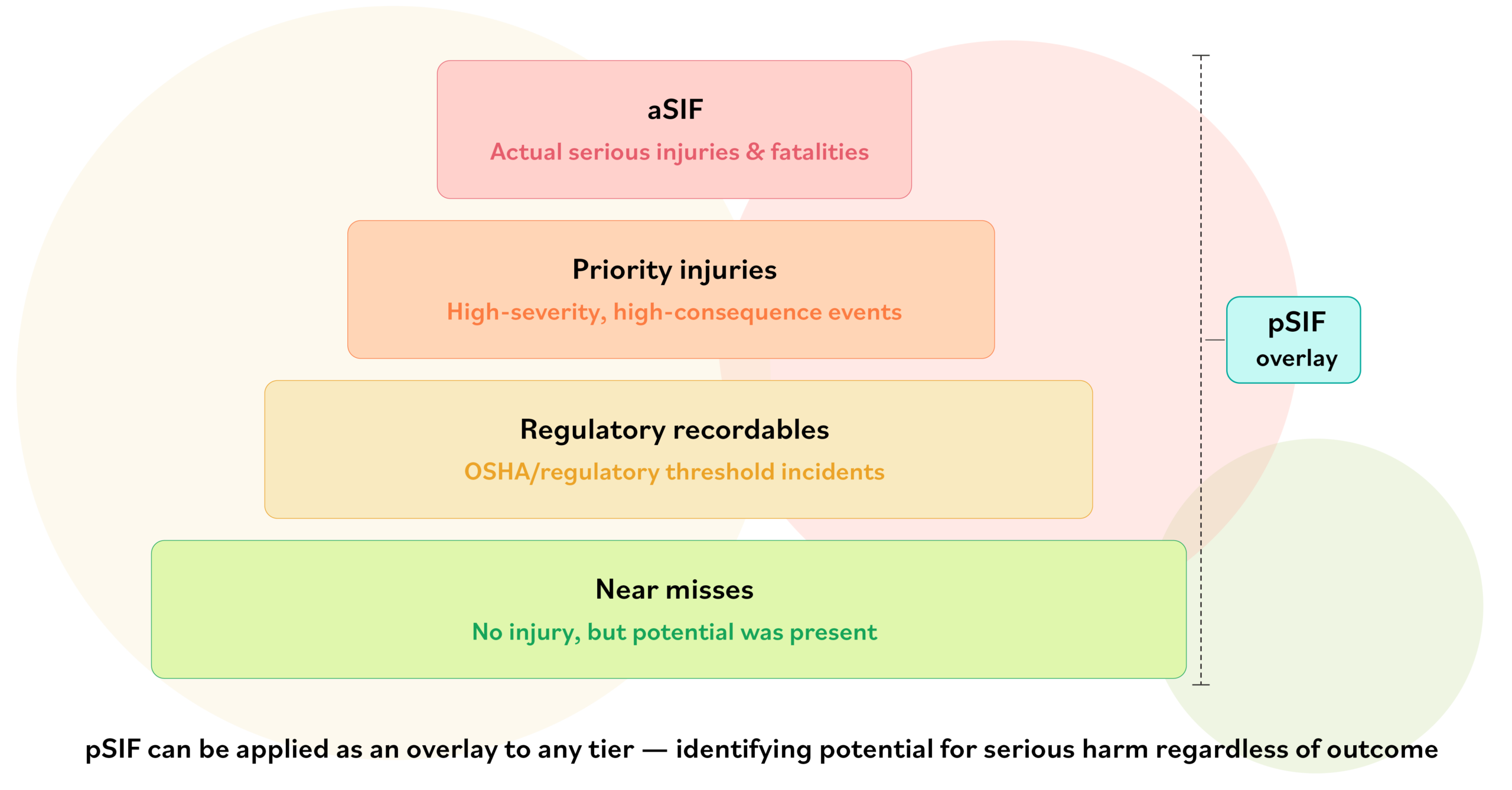
Additionally, this standard includes a SIFRisk classification, which goes beyond incident recording to capture hazardous system conditions, and constraints created by processes or the work environment that have the potential to result in a serious injury or fatality if left unaddressed. The standard is designed with benchmarking in mind, enabling meaningful comparison across organizations, industries, and even international borders.
The EEI SCL Model overview
The EEI SCL Model, developed by a working group of 20 safety leaders and technical advisor Dr. Matthew Hallowell, takes a decidedly different approach. Built for the electric power sector, though its logic applies broadly, the SCL Model is a decision-based classification tool grounded in the science of energy-based safety.
It categorizes incidents and observations into seven distinct types (HSIF, LSIF, PSIF, Capacity, Exposure, Success, and Low Severity) based on four objective yes-or-no questions: was high energy present, was there a high energy incident, was a serious injury sustained, and was there a direct control present.
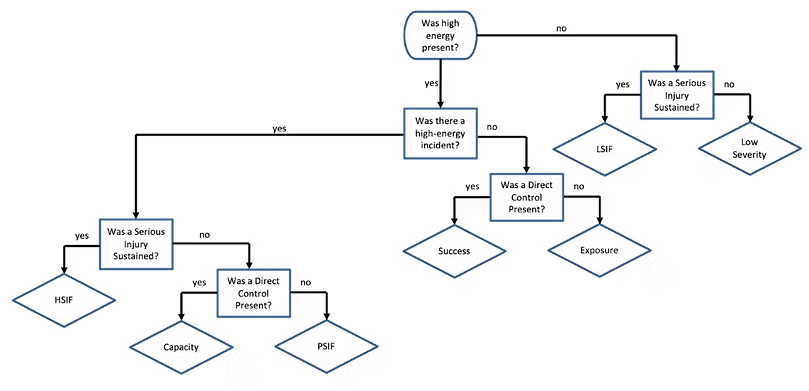
This work was prepared by the Edison Electric Institute (EEI)
The model uses a a rules-based framework to more consistently classify events inside and across organizations. It was tested on real-world cases and when deployed, it improved classification consistency of incidents from 65% to 95% agreement among a group of experienced safety professionals.
| ASTM E2920-26 | EEI SCL Model | |
|---|---|---|
| Primary purpose | Recording & measurement standard for consistent incident documentation | Decision-based learning tool for improving classification and investigation quality |
| Target sector | Global, cross-industry | Electric power sector (broadly applicable) |
| Classification system | Tiered severity: aSIF, pSIF, priority, recordable, near miss + SIFRisk overlay | 7 types (HSIF, LSIF, PSIF, Capacity, Exposure, Success, Low Severity) via 4 yes/no questions |
| pSIF identification | Hazard typology + scenario-based appendix (thorough, more interpretive) | Energy threshold (500 ft-lbs) decision tree (objective, reduces variability) |
| Metrics orientation | Built for cross-org and industry benchmarking | Intentionally not metric-driven initially — prioritizes learning over measurement |
| Best fit for | Multi-jurisdiction orgs, supply chains, regulatory alignment, external reporting | Internal learning systems, investigation quality, SIF elimination programs |
Where ASTM E2920-26 and EEI SCL Model overlap
Both frameworks share a foundational belief that traditional lagging indicator metrics, like total recordable injury rate (TRIR), are insufficient for driving meaningful progress on the most serious outcomes.
Both recognize the value of the pSIF concept: incidents that did not result in a serious injury or fatality, but had the potential to do so, offer rich learning opportunities and deserve serious investigative attention.
Both also emphasize that the presence or absence of controls (or safeguards, in ASTM’s language) is a critical variable in understanding the nature of an incident.
And perhaps most importantly, both push organizations to look beyond outcomes and toward the conditions and circumstances that created risk in the first place. This is reflected in ASTM’s SIFRisk classification and the SCL Model’s Exposure classification, both of which are designed to capture and classify dangerous conditions before any incident occurs.
Where ASTM E2920-26 and EEI SCL Model diverge
The most significant difference between the two frameworks lies in their primary purpose.
ASTM E2920 is fundamentally a recording and measurement standard.
- It is built to answer the question: how do we classify and count what happened, in a way that is consistent enough to benchmark across the industry?
- The SIFRisk classification does extend ASTM’s reach into proactive territory, but the standard’s overall architecture is still oriented toward consistent documentation and cross-organizational comparison.
The SCL Model, by contrast, is designed as a learning tool first.
- Its creators were emphatic that the model should not initially be used to generate metrics.
- Doing so, they argued, risks creating incentives that suppress reporting and undermine learning (if you track a pSIF metric, you risk gaming the pSIF metric).
Formal operational definitions of safety success
The SCL Model also introduces something that ASTM E2920-26 does not: formal operational definitions of safety success.
When a high-energy hazard is present and a properly installed and verified direct control is in place, the SCL Model calls that a “Success”. Likewise, when there is a high energy exposure, that resulted in an incident, but a direct control mitigated a serious injury, this is classified as a “Capacity” event. These are data points that are worth capturing and studying and they are typically missed in traditional event classifications.
ASTM E2920-26 does not go this far, its scope is centered on injuries, illnesses, and the conditions that could produce them, not on formally cataloguing safe performance.
Specificity
Another meaningful difference is specificity.
The SCL Model’s energy-based framework gives practitioners a quantifiable threshold, 500 foot-pounds of physical energy, as the dividing line between high and low energy. This makes classification more objective and reduces the interpretive variability that has historically plagued pSIF identification.
ASTM E2920-26 approaches pSIF identification through a hazard typology and scenario-based appendix, which is thorough but leaves more room for subjective interpretation. Neither approach is wrong, they reflect different design philosophies for different use cases.
| ASTM E2920-26 | EEI SCL Model | |
|---|---|---|
| Where they overlap | ||
| Shared critique | Both reject traditional lagging indicators (e.g. TRIR) as sufficient for preventing the most serious outcomes | |
| pSIF concept | Both recognize that incidents without a serious outcome, but with the potential for one, deserve serious investigative attention | |
| Role of controls | Both treat the presence or absence of controls (or safeguards) as a critical variable in understanding any incident | |
| Proactive hazard capture | Both extend beyond outcomes to classify dangerous conditions before an incident occurs — via SIFRisk (ASTM) and Exposure (SCL) | |
| Where they diverge | ||
| Primary purpose | Recording and measurement — built for consistent documentation and cross-org benchmarking | Learning and classification — built to improve investigation quality and consistency |
| Metrics orientation | Intentionally designed to generate benchmarkable metrics across industries and borders | Deliberately avoids metrics-first use — creators warn this risks suppressing reporting |
| pSIF identification | Hazard typology and scenario-based appendix — thorough but more open to interpretation | Objective energy threshold (500 ft-lbs) via 4 yes/no questions — reduces interpretive variability |
| Captures safe performance | No — scope is injuries, illnesses, and conditions that could produce them | Yes — Success and Capacity classifications formally document when controls worked |
Which framework is right for your organization?
When your priority is measurement and benchmarking
If your organization’s priority is global benchmarking, regulatory alignment, and standardized recordkeeping that can be compared across business units or supply chains, ASTM E2920-26 is a strong fit.
It is purpose-built for that function and aligns with internationally recognized management system standards like ISO 45001 and ANSI/ASSP Z10.0. Organizations operating across multiple jurisdictions or those looking to participate in industry-level benchmarking will find E2920’s structure particularly useful.
When your priority is learning and investigation quality
If your organization is looking to build a more robust internal learning system, one that improves the consistency of classification, redirects investigative energy toward the incidents with the greatest learning potential, and ultimately works toward the elimination of SIFs, the SCL Model offers a disciplined, rules-based and evidence-based path.
The good news is that the two are not mutually exclusive. Organizations can use ASTM E2920-26 as their recording and external-facing classification system while deploying the SCL Model internally to drive learning and investigation quality. In fact, the SCL Model’s creators note that its four decision-point questions can be programmed directly into most safety management systems, which means integration with existing recordkeeping workflows is achievable.
The bottom line
Both ASTM E2920-26 and the EEI SCL Model represent meaningful advances in how the EHS profession thinks about serious incident prevention. They approach the same fundamental problem (the persistent plateau in Fatality rates despite declining recordable injuries) from different angles.
Understanding those angles is what allows practitioners to apply each framework where it will do the most good. The question is not which one wins, but which one serves the specific job your organization is trying to get done.
Want to know more about the SCL Model? Read this 4-minute article.
References
1. ASTM International. (2026). ASTM E2920-26: Standard Guide for Recording Occupational Injuries and Illnesses. West Conshohocken, PA: ASTM International. https://www.astm.org/e2920-26.html
2. Edison Electric Institute. (2024). Safety Classification and Learning (SCL) Model (Revised September 2024). Washington, DC: Edison Electric Institute. Available at: https://www.eei.org