
Safety Classification and Learning Model: The Framework for Consistent Learning
February 3, 2026
4 minute read

When an incident occurs, how do you classify it? Is it a serious injury and fatality (SIF)? A potential SIF? When people answer that question differently, it becomes a data quality and a resource allocation nightmare.
Research conducted by the Edison Electric Institute demonstrated this problem. When safety professionals classified the same incidents without a structured framework, they only agreed 65% of the time. If you can’t categorize data consistently, you can’t learn from it.
What Is the safety classification and learning model?
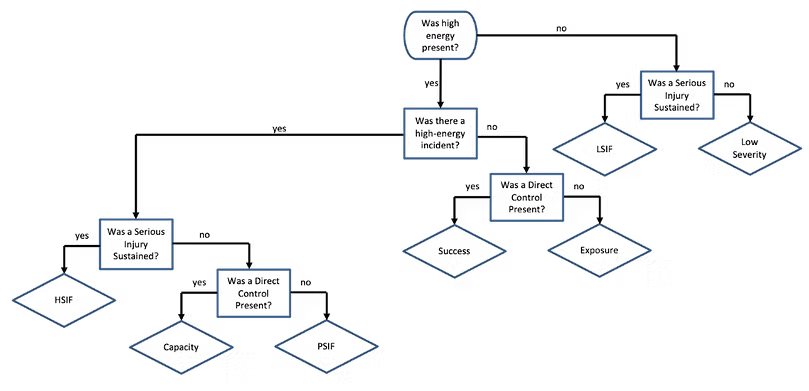
The Safety Classification and Learning (SCL) Model, developed by the Edison Electric Institute, provides an objective method for classifying safety events using four simple yes/no questions:
1. Was high energy present?
- >1500 Joules of physical energy, reference the 13 high-energy icons.
2. Was there a high-energy incident?
- An incident is defined as an instance where the high-energy source was released and where the worker came in contact with or proximity to (within 6ft) the high-energy source.
3. Was a serious injury sustained?
Serious injuries include life-ending, life threatening, and life-altering events.
- Life-threatening: A physical injury that if not immediately addressed is likely to lead to the death of the affected individual and will usually require the intervention of life sustaining support by external emergency response personnel or colleagues.
- Life-altering: A physical injury that results in permanent loss of use of an internal organ, body function, or body part.
4. Was a direct control present?
A direct control is defined as one that:
- Specifically targets the high-energy source
- Effectively mitigates exposure to the high-energy source when installed, verified, and used properly (i.e., a SIF reasonable should not occur if these conditions are present), and
- Is effective even if there is unintentional human error during the work (unrelated to the installation of the control).
This work was prepared by the Edison Electric Institute (EEI)
Based on your answers, the model categorizes events into one of seven classifications organized by learning priority:
Tier 1 (highest priority)
- High-energy SIF: High-energy incident causing serious injury.
- Low-energy SIF: Low-energy incident causing serious injury.
- Potential SIF (PSIF): High-energy incident, no serious injury, no direct control present.
Tier 2 (moderate priority)
- Capacity: High-energy incident, no serious injury, direct control present.
- Success: High energy present, no incident, direct control present.
- Exposure: High energy present, no incident, no direct control.
Tier 3 (lower priority)
- Low severity: Low-energy incident, no serious injury
Why consistent classification matters
You can use the safety classification and learning model for incidents, near misses, and energy-based observation outcomes.
Applying the same framework to both leading and lagging indicators allows for consistent classification and analysis, which isn’t possible with separate systems.
Linking your leading and lagging indicators with the SCL model gives you deeper insights into your data.
For example, if your injury data shows most High Energy SIFs involve Excavation or Trench hazards over 5 feet, but your EBO data shows these hazards consistently have Direct Controls and are marked as “Successes” through the SCL model, that discrepancy demands investigation. Are controls being bypassed? Are they failing in unexpected ways? Is another type of exposure happening?
Without consistent classification, you’d never spot this pattern.
The PSIF learning opportunity
Potential SIFs deserve special attention. A PSIF has all the same characteristics as an actual High or Low Energy SIF, except that no one was seriously hurt, someone was just lucky.
These events are far more common than actual SIFs, so they offer valuable learning opportunities without the tragedy of death.
By systematically identifying and investigating PSIFs, you can spot weaknesses before a serious injury or fatality occurs.
The 95% consensus achievement
After implementing the Safety Classification and Learning Model developed by the Edison Electric Institute, the same safety professionals improved their agreement from 65% to 95%.
That improvement enables meaningful trending, valid benchmarking, and shared learning within your organization and across organizations.
When everyone speaks the same language, collective intelligence becomes possible.
What the SCL model brings to your EHS management system
The SCL Model connects everything:
- Investigation prioritization: Allocate resources to Tier 1 events deserving thorough analysis
- Management system integration: Classify incidents, near-misses, and observations using one framework
- Strategic focus: Be more strategic with your data analysis and time allotment using the standardized classification outputs
HECA: Driving Safer, More Effective Outcomes and Reducing SIF Risk
View a live walkthrough of Intelex’s HECA application, a new solution unlike anything else on the market.
Aligned to Safety Function’s HECA™ methodology, it’s designed to help teams consistently evaluate high‑risk work, compare the strength of controls, and take action before serious harm occurs.
In under 60 minutes, you’ll understand what really prevents serious injuries and how to put it into practice.

Standardize your event classification
Intelex has incorporated similar event classification principles across our platform.
Leveraging standardized event classification allows you to link your leading and lagging indicators through a common framework in order to drive better trend analysis and corrective action in your safety management system.
Book a call to see how it works.
References
Hallowell, M.R. (2024, September). Safety classification and learning (SCL) model (2nd rev.). Edison Electric Institute.
Oguz Erkal, E.D. & Hallowell, M.R. (2023, May). Moving beyond TRIR: Measuring and monitoring safety performance with high-energy control assessments. Professional Safety, 68(5), 26-35.