
Why Food Safety, Quality, and Production Issues Rarely Stay Contained
March 24, 2026
7 minute read
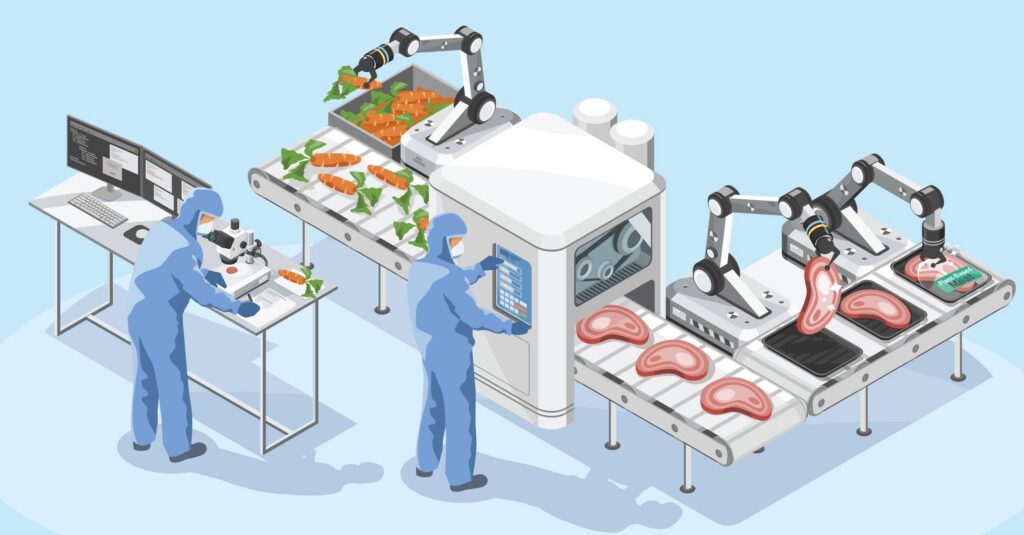
In food & beverage, most operational inefficiencies stem from important information never reaching the right team.
Sometimes the issue seems minor, like finding broken glass near a conveyor belt.
Quality sees a process control problem. Safety sees a housekeeping problem. Production sees a yield loss problem.
All three teams are facing the same root cause, but none of them realize it. And that small issue can balloon into a costly failure.
Here’s what that looks like in practice, and what it can cost when teams don’t share information.
How manual processes create compounding risks
“You can do your job through manual systems, less efficiently, but similar to how you would do it with technology,” says Angelo Cianfrocco, Intelex EHS Solutions Consultant. “The real issue is that without a single system to bring all the information together, data and work end up stuck in separate silos.”
Despite these risks, many organizations are slow to change.
Food and beverage teams tend to be risk-averse, viewing changes to established processes as too disruptive, especially during critical production periods. Leadership often perceives the risk of adopting new systems as greater than the potential benefits.
Additionally, many teams believe their processes are too customized for food safety and quality management software. Departments create their own ways of working, with special management systems, naming conventions, and workflows, assuming no software can accommodate this complexity. As long as the process works for them, they see no reason to change.
However, a process that works for one department can create hidden risks if other teams cannot access its information. This risk appears in four key areas:
1. HACCP and CCP logging
When HACCP and CCP forms are filed manually, establishing accountability and clear next steps becomes increasingly difficult. While a department may have established best practices for following up on a food safety incident, when records live in binders or isolated spreadsheets, they aren’t connected to a workflow that triggers corrective action across departments.
Because of this, Quality teams may never see patterns that Safety teams are tracking, and vice versa. Issues that could have been resolved quickly languish and only surface during audit. By then, what could have been a simple remediation has potentially impacted multiple teams across multiple production cycles.
2. Training administration
Properly trained employees are better equipped to meet safety and quality goals. But training itself becomes a risk vector when you track it manually, particularly in the food and beverage industry, where seasonal and contract workers have high turnover.
When training records exist on paper or in disconnected spreadsheets, supervisors across departments can’t quickly verify credentials before assigning tasks. As a result, one of two things happens: Gaps emerge where untrained workers handle critical tasks, causing Safety and Quality to suffer. Or unnecessary retraining pulls workers off production lines, causing Production to suffer. Either way, risks compound.
3. Audit and certification prep
Daily inspections and corporate audits are often kept separate. Each site and team organizes records differently. If documentation is collected manually, it’s often scattered across drives, binders, and email chains. This creates audit and certification risk. “When you have manual, siloed systems, you’re looking at everything like in a snapshot, instead of looking at it as a trend for your entire location over time,” says Angelo.
Because no one has a consolidated view, leaders can’t spot patterns until problems affect multiple sites. Lack of visibility makes passing an audit harder, risking shutdowns if an audit fails. The reconciliation process itself consumes days or weeks of staff time that could be spent on actual improvements.
4. Incident and nonconformance tracking
Quality, Safety, and Production incidents frequently have a common root cause. A spike in product rejects on a bottling line and three slip-and-fall incidents in the same area may both trace back to a leaking filler. Quality sees a yield problem. Safety sees a housekeeping problem. But if each team logs issues in their own system, root causes may remain unresolved for months.
When teams are stuck in silos and reliant on manual processes, resolving the problem once it’s known can be just as difficult. If follow-up depends on someone remembering to check a paper log or spreadsheet, corrective actions can pile up with no automated reminders or accountability.
How a minor issue becomes a major crisis
Consider the earlier broken glass example. Here is how such a scenario typically unfolds:
A worker reports broken glass around a conveyor. Safety cleans it up and files a report on paper or in an non-shared digital drive. Quality never sees it. Production doesn’t flag it.
Weeks later, more reports come in from the same location. Leadership is finally compelled into action, and an investigation reveals that the conveyor is running at the wrong speed, causing bottles to crack. By now, the damage has multiplied: product is potentially compromised, batches go on hold, and recall risk looms.
“A Safety issue can turn into a Quality issue,” Angelo says. “But if you’re collecting information in siloed systems, you can’t connect those dots.”
The business impact can be substantial: production downtime, recall costs, loss of customer trust, and potential contract loss. A minor issue becomes a six-figure problem. And when workers see reports ignored, they lose faith in the system, making it harder to foster a proactive reporting culture..
The pattern is predictable: Safety sees symptoms but lacks equipment and data from Quality. Quality misses Safety reports that could have signaled process deviations. Production tracks output but doesn’t flag mechanical issues to other teams.
Each department addresses symptoms in isolation. Manual processes prevent information from prompting cross-functional action.
What changes when systems are connected
Software platforms that centralize Safety, Quality, and Production data give cross-functional teams visibility into patterns and trends that manual processes obscure.
Here’s the same scenario with food safety and quality management software in place:
A worker scans a QR code and submits a report with a photo. The issue is routed to supervisors in both Safety and Quality immediately. Safety triggers a corrective action to address the hazard. Quality begins by investigating how the glass broke in the first place, and their findings lead to equipment adjustments that stop the problem at the source.
Critically, everyone sees the follow-through. Reporting leads to visible action, reinforcing a culture where employees feel empowered to report issues.
The cost of waiting
The risks described here don’t arrive as sudden crises. They build quietly across production cycles, across departments, across months of reports that never find their way to the right desk.
The question is not whether your teams encounter these problems. (Because they do).
The question is whether your systems are designed to surface them before they compound, or after.
See how leading food and beverage teams are using food safety and quality management software to connect data and identify and address problems before they escalate. Read How Intelex Helps Food & Beverage Teams Run Safer, Smoother Operations.