
The EHSQ Maturity Index: How to Improve EHSQ Performance in Your Organization
July 28, 2026
Every company is on its own EHSQ journey. Most have basic policies, some training, and increasingly, dedicated software.
Even so, it is hard to know where you stand — what you do well and where you fall short. Most EHSQ professionals rely on experience, peer advice, and instinct to fill that gap.
That’s where this maturity index comes in.
It’s based on our experience working with thousands of organizations across multiple industries. It’s designed to help you get your bearings and find tangible ways to improve.
The three levels of EHSQ maturity
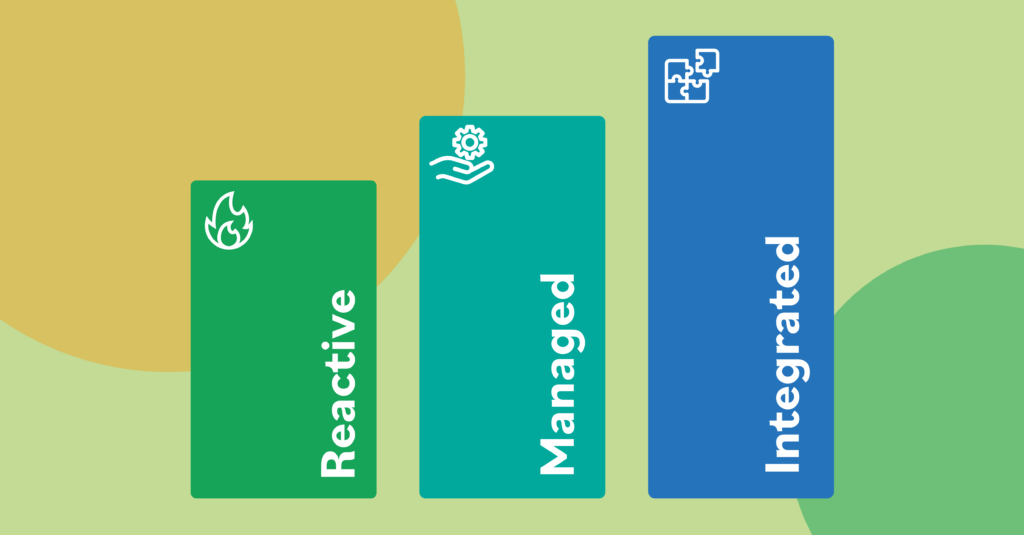
This guide maps EHSQ maturity across three levels — Reactive, Managed, and Integrated — so you can see your current stage and understand what steps you need to take to progress.
| Reactive | A business surviving on heroics and hindsight. Incidents drive action. Compliance is a scramble and data sits in silos. |
| Managed | Processes and structure exists. Responsibilities are clear, problems are handled with less drama. The organization does more things right, but EHSQ isn’t a strategic advantage yet. |
| Integrated | EHSQ is how the business runs, not a layer on top. Safety, quality, waste, risk, and data all connect. Insight replaces surprise and EHSQ becomes a strategic advantage. |
One caveat: You might be Integrated in one area and Reactive in another. Even the top level always has room to improve.
How EHSQ maturity is measured
Moving from one maturity level to another means bringing together thinking, behavior, and technology. It demands answers to fundamental questions across five core dimensions:
- Regulatory management: Is compliance a burden or a competitive edge?
- Culture and engagement: Is doing the right thing your teams’ default?
- Risk intelligence: Can you spot both known hazards and emerging threats?
- Leadership and governance: Do your leaders back EHSQ in practice, not just words?
- Learning from data: Can you make sense of your data and act on it?

This guide walks through each dimension: what every level looks like in practice, what keeps organizations stuck, and what unlocks the next stage
The goal isn’t a perfect score. It’s an honest picture of where you stand and a clear view of what to do next.
Dimension 1: Regulatory management
Regulation sets the rules in advance, in public. Regulatory management decides whether those rules become constant fire drills or quiet, compounding advantages.
This section looks at how well you turn compliance requirements into engineering controls, procedures, and routines.
Reactive: Compliance as damage control
At the Reactive level, regulation is something done to you, not something you manage.
Compliance work spikes around external triggers. I.e., an inspector visit or an incident. The rest of the time, it remains a vague sense of risk rather than a defined workload.
Understanding of requirements is narrow and local. Supervisors and engineers know the few rules that bite them daily, but there’s no complete inventory of legal, customer, and internal requirements across sites, processes, and products. Edge cases, changes, and new activities live in a gray area because no one checks what applies.
Most tracking is manual. Spreadsheets, shared folders, and paper files try to hold permits, licenses, inspections, risk assessments, procedures, and reports together but do a poor job.
Compliance quality depends on the memory and diligence of a few people. Often a single “compliance person” interprets everything for everyone else.
Engineering controls and procedures change after the fact. Guards, interlocks, signage, and SOPs get added after incidents or customer pressure, not from a structured translation of obligations into design and work instructions.
Change management is weak or informal. New equipment and processes can go live with only partial thought for regulatory consequences.
Nothing systematically monitors regulatory change. New standards, tighter limits, and added reporting duties surface late through citations, audit findings, or an advisor’s offhand comment.
Training is inconsistent and undocumented. People learn on the job instead of being deliberately equipped. Above all, compliance is treated as an administrative burden, separate from how the business creates value which guarantees it stays under-resourced and a step behind.
Managed: Compliance as a system
Managed organizations stop treating compliance as random noise and start treating it as a knowable, plannable workload.
A documented compliance and regulatory management system sets out roles, responsibilities, and core processes for identifying, assessing, and implementing requirements. A structured compliance register catalogs permits, licenses, regulatory clauses, customer requirements, and internal standards. Each with clear ownership, applicability, and controls.
Engineering controls and procedures are increasingly derived from this register. Requirements become design criteria, operating limits, inspection routines, and SOP content, rather than patched on after the fact.
A compliance calendar tracks renewals, inspections, and reports so deadlines surface early. SOPs cite the regulations they satisfy, making the link between “rule” and “how we work” visible.
Internal audits are routine and structured, comparing real practices and controls against requirements. Findings get logged, owned, and tracked to closure. Corrective and preventive actions follow a basic workflow: raised, assigned, due-dated, verified.
Training becomes systematic and role-based, with completion and competency recorded. Periodic external reviews validate interpretations and expose gaps, cutting the “we’ve always done it this way” blind spot.
Some automation appears. Safety and environmental data pre-populate parts of reports and dashboards. Compliance metrics like overdue actions, upcoming renewals, and audit closure rates reach management regularly.
Regulatory and compliance factors appear inside operational workflows, not just in binders on a shelf. At this level, you can see your obligations, measure performance, and manage the workload with less drama.
Integrated: Compliance by design and advantage
Integrated organizations treat regulatory compliance and other obligations as design inputs to how they build plants, write software, design products, and run operations. Compliance is embedded so deeply that most of the time it happens without conscious effort.
Horizon scanning is institutionalized. Dedicated tools and partners track emerging regulations, standards, and customer expectations across jurisdictions, turning raw change into structured impact assessments. The question shifts from “What changed last year?” to “What’s likely to change next, and how do we get ahead of it?”
Automated monitoring closes the loop between obligations and performance. Real-time data from operations, engineering systems, and EHSQ platforms feed rules engines and analytics that flag early deviations such as emission drifts, process deviations, overdue inspections, training gaps, and control bypasses.
Design and engineering work from a compliance-by-design philosophy. Equipment specifications, layouts, controls, and procedures are developed using libraries of standard requirements and proven control strategies. Engineering controls are favored over administrative controls and PPE whenever feasible. This preference is built into templates, standards, and approval workflows.
Governance is cross-functional and senior. Operations, engineering, legal, EHSQ, finance, and commercial leaders jointly oversee regulatory management as part of the enterprise risk and strategy agenda, not as a specialist side topic. Compliance performance is reviewed alongside financial and operational metrics with equal seriousness.
Predictive analytics model how upcoming regulatory and contractual changes might affect portfolio mix, cost structure, capacity, and site strategy. This allows the business time to adjust investments, renegotiate contracts, redesign products, or shift footprints ahead of competitors.
Integrated organizations engage with regulators, standards bodies, and industry groups. They participate in consultations, pilots, and working groups, helping shape what “good” will mean in the next decade.
Continuous verification through integrated platforms replaces point-in-time audits. Leaders can see where they stand at any moment. Performance consistently beats the minimum, and the market notices: faster approvals, smoother customer audits, better contract terms, and a visible trust premium competitors can’t easily copy.
The rules that slow others down become part of how you run faster, with fewer surprises.
How Intelex can help
- Build a single register of all your regulatory, permit, and internal obligations. A Reactive compliance program is defined by knowledge living in people’s heads rather than in a system. When the “compliance person” leaves, the knowledge leaves with them. The first structural step is consolidating all regulatory, permit, customer, and internal requirements into one place with clear ownership, due dates, and status. Intelex Legal Requirements centralizes obligations with assigned owners, configurable escalations, and workflow status tracking that shows what is upcoming, due, or overdue.
- Automate the compliance calendar. The shift to Managed requires breaking complex requirements into discrete tasks, assigning them to the right people, and ensuring deadlines appear automatically rather than relying on memory. Intelex Compliance Tracking parses regulations into individual tasks and subtasks with visible accountability. It uses a month-based calendar to display upcoming deadlines and supports threshold-exceedance warnings and automated escalations.
- Make procedures and SOPs living documents that reference the obligations they satisfy. At the Reactive level, procedures exist, but their connection to the regulations they satisfy is invisible. When regulations change, no one knows which procedures are affected. Intelex Document Control centralizes the full lifecycle of compliance and process documentation with automated review and approval workflows, version control, and access controls that ensure only current approved documents are in use.
- Get ahead of regulatory changes. Integrated organizations know what’s coming and have already assessed the impact before new rules take effect. This requires a structured regulatory horizon-scanning process rather than relying on advisors, citations, or industry newsletters. Regulatory Content Integrations from Enhesa and RegScan combine with the power of Intelex’s EHSQ software solutions to easily manage all of your compliance-related data and activities in one central location.
- Embed compliance review into operational and engineering changes before go-live. Moving to Integrated means compliance is a design input. Management of Change structures every change request through evaluation, hazard and nonconformance identification, approval, and implementation phases, with a centralized repository that records compliance assessments before work begins.
- Connect permit thresholds and environmental data to automated compliance monitoring. Integrated regulatory management replaces point-in-time audits with continuous verification. Intelex Permits Management centralizes all permit thresholds, dates, and performance data, and sends automated alerts when emissions approach exceedance limits.
- Use real-time environmental monitoring to catch deviations. At the Integrated level, compliance is verified continuously, rather than appraised through periodic audits. Intelex Assets and Compliance Tracking System (ACTS) functions as a calculation, task management, and reporting engine simultaneously, processing over one million calculations per hour across air, water, soil, and waste media
- Keep your regulatory exposure profile current. A register accurate today can be dangerously stale in 18 months. Intelex Applicability Analysis supports scheduled recurring assessments that automatically review whether the regulatory profile for each site remains accurate, with stop-light dashboards that surface gaps in coverage.
Dimension 2: Culture and engagement
Culture is the part of EHSQ that money can’t buy.
You can hire consultants, buy software, and wire up sensors. But how people behave when no one’s watching? That’s earned, and it takes time.
Culture and engagement reveal your maturity most clearly: who speaks up, who stays quiet, who takes responsibility, and who assumes it’s someone else’s job. This is how an organization turns passive participants into owners.
Reactive: Compliance on paper, silence in practice
The organization talks about safety, quality, and environmental responsibility but the culture says otherwise. People learn the safest career move is to keep their head down.
Participation is minimal. Committees are absent or ceremonial; real decisions happen elsewhere. Reporting systems exist but only capture the undeniable: injuries, major incidents, releases too visible to hide.
Psychological safety is low. Raise a concern and you risk being labeled negative or “not a team player.” Mistakes are personal failures, so people hide them or quietly fix them.
The culture is “us versus them.” Management enforces rules; workers avoid trouble. EHSQ is something “the EHS and quality teams” do, not how everyone works.
The result looks good on dashboards and dangerous in real life. Problems travel faster through gossip than reporting channels. By the time something reaches leadership, it’s too big to ignore and too late to fix cheaply.
Managed: Voices begin to matter
Managed organizations realize culture is not slogans. It’s what people experience every day. So they build structures that make participation possible and safe.
Committees and working groups focused on EHS and quality now include frontline employees who have real input into procedures, risk assessments, and improvement ideas. Not every suggestion is adopted, but more of them are heard and acknowledged.
Leaders explicitly say, “We’d rather hear about ten small problems than one big one we missed.” Psychological safety starts trending up. Line managers are coached to respond constructively; blame is challenged, not celebrated.
Recognition shifts. People are thanked for speaking up early and helping fix systemic issues, not just for “no incidents.” The organization rewards the behaviors that prevent incidents, not the absence of them.
Ownership is more distributed in everyday practice. Supervisors treat EHSQ as part of running the business, and frontline workers get pulled into how work actually happens versus how procedures imagine it. Culture becomes an enabler.
Integrated: Culture as a force multiplier
Integrated organizations treat culture and engagement as a competitive advantage. Technology and process matter, but nothing scales without confident, willing people.
Psychological safety is designed into the system. People bring their full selves to work. Diverse perspectives are sought because leaders know a room full of people who think alike misses things.
Trust underpins all of this. People believe what leaders say and trust colleagues have their backs. Without that, every other cultural attribute is theater.
Speaking up is systemic, not dependent on your manager. Anyone can stop work, question a decision, or flag a risk without fear of retaliation. Leaders demand it, because their job is removing barriers and developing people
Silence is considered a risk. Reporting isa contribution, not a confession. High volumes of observations and near-misses are celebrated as signs of a healthy system. Mistakes are information. People grow because the organization invests in them as problem-solvers.
Ownership is truly distributed. EHSQ responsibilities are built into every role, from procurement to design, operations to finance. The EHS and Quality teams become coaches, spreading expertise. People understand how their work connects to the organization’s purpose, and that clarity creates motivation rules never could.
The organization distinguishes between human error, at-risk behavior, and reckless choices, responding differently to each. After an incident, defect, or compliance failure, the default question is, “What about the system made this possible?” not “Who do we blame?” Accountability is present, but paired with fairness. Standards are applied consistently, free from favoritism or selective enforcement. High performers see that performance matters; everyone sees that rules apply equally regardless of tenure, title, or relationships.
Worker participation becomes structural. Frontline employees help design controls, refine standards, and choose tools. Peer coaching and local improvement teams are the norm.
And it shows up in numbers the business cares about: reporting climbs, actions close faster, repeat issues fade, retention improves, transitions run smoother. Customers and regulators feel it on site. The boardroom story matches the shop floor.
At this level, culture carries the same strategic weight as capital allocation. It’s how you execute when the unexpected hits. Systems provide the framework, but the judgment of people who feel safe, informed, and responsible carries you through.
You can copy someone’s technology. You can’t copy an organization where 800 people care enough to surface small problems before they become big ones. That’s what maturity actually looks like.
How Intelex can help
- Give every worker a low-friction way to speak up. Friction is the biggest enemy of near-miss reporting. Near Miss Reporting Software makes it simple to capture close calls on any device, automatically routing serious concerns to the right people and triggering investigations and corrective actions. The result is a steady stream of leading-indicator data for spotting patterns and preventing incidents.
- Make observations a daily habit.Observation Management Software lets any employee capture a behavior, condition, or hazard in real time from their phone, attach a photo, and assign a follow-up action. High-risk observations can automatically trigger a near miss or CAPA, so serious concerns don’t get lost.
- Close the loop publicly and visibly when workers speak up. People stop reporting when nothing appears to happen as a result. Intelex Bulletins enables targeted, trackable communications to any audience across any device, so the organization can demonstrate that speaking up leads to action.
- Build a structured, data-driven behavioral safety program. Define the specific behaviors that matter, observe them systematically, and analyze patterns across shifts, teams, and locations. Intelex Behavior-Based Safety supports the full cycle, with embedded analytics and automatic CAPA triggers for high-risk behaviors.
- Turn engagement into numbers that leaders can manage. Reporting volume, suggestion rate, action closure time, and participation in investigations are leading indicators of a healthy system — they belong in the same operational review as production output and cost variance. Action Plans centralizes all open CAPAs with status dashboards, automated notifications, and closure tracking visible across leadership tiers.
- Build manager capability to respond to human error consistently. Inconsistency in handling mistakes is one of the biggest destroyers of psychological safety. Training Management deploys role-specific training modules across locations, tracks completion in real time, and verifies that managers absorb instruction on just culture principles, incident response, and constructive feedback — with mobile microlearning support for frontline workers.
- Improve the quality of what gets reported. At this stage, you have volume. The question is whether reports are rich enough to act on. Intelex Input AI improves report quality at scale. Faster, easier reporting drives higher frontline engagement and ensures every submission is complete, consistent, and analysis-ready.
- Make performance visible to everyone. Culture health shows up in numbers, but only if they’re surfaced consistently. Reports & Dashboards embed directly within day-to-day EHSQ workflows, so any business user can visualize and benchmark reporting and closure rates across sites to identify where culture is strongest and where it needs attention.
Dimension 3: Risk intelligence
Risk intelligence is the difference between being surprised by risk and being merely disappointed by it.
Everyone has hazards. Everyone has threats. The question is whether you treat risk as a static list to maintain or a moving picture to interpret.
This section is about how well your organization sees what’s right in front of it (and what’s coming around the corner).
Reactive: Risk as history
At the Reactive level, risk is whatever has already gone wrong. The risk register, if it exists, is a rarely visited record of past incidents and obvious hazards. It reflects what regulators care about and what auditors asked last time, not what’s changing in your environment.
Risk identification is limited to known hazards: the machine that’s always noisy, the chemical everyone respects, the area with a history of slips. If it’s in last year’s reports or on a checklist, it’s on the radar. If it’s new, slow-burning, or crosses functions, it isn’t.
Risk awareness lives in individuals’ heads, not in the system. An engineer worries about a control system vulnerability. A supervisor distrusts certain contractors. A buyer sees a fragile supplier. These concerns stay in conversations and inboxes, not in a shared view of risk.
External factors like technology shifts, climate volatility, new regulations, and supply chain fragility are treated as background noise. They’re interesting but not relevant to the here and now.
There’s no horizon scanning, no scenario planning, no line between today’s operational risks and tomorrow’s strategic ones. The register gets updated irregularly, usually right before a review.
At this level, risk is defined by hindsight. You recognize a new category only after it has already cost you.
Managed: Risk as a process
Managed organizations accept that risk changes constantly, so they build a system to keep up.
They run structured risk assessments regularly. Workshops, checklists, and facilitated sessions identify operational risks across functions. The process is repeatable and not dependent on any single person’s memory.
A live risk register is maintained and reviewed quarterly. Risks are scored, owners assigned, and treatments documented. This lets management see a hierarchy of critical, moderate, and monitored risks.
Emerging threats enter the conversation. Industry incident reports, regulator alerts, and peer failures are scanned and sometimes translated into local risks: “Could that happen here? How?”
A cross-functional risk committee meets periodically to review known hazards and potential new threats. Operations, EHSQ, maintenance, IT, and supply chain share perspectives. The blind spots shrink even if they still exist to a degree.
Employee suggestion schemes, whistleblowing channels, and feedback loops capture some frontline insight. Drivers may flag new road risks. Technicians may note worrying wear patterns. Factory workers let the business know about things that don’t feel right. Not everything is formalized, but more signals reach the system.
This level is where basic scenario analysis starts to take shape:
- “What if that regulation tightens?”
- “What if this new automation fails?”
- “What if we lose that supplier?”
These exercises stress-test current controls and identify weak points. Mitigation plans are built for medium and high risks, including actions, timelines, and trigger points. Progress is reviewed in management meetings, where “emerging risk” becomes a regular agenda item rather than a side note.
At the Managed level, risk intelligence is no longer an afterthought. It’s a process. It may be imperfect, but it’s a lived part of how the business operates.
Integrated: Risk as a strategic catalyst
Integrated organizations treat risk intelligence like a sense organ. It’s always on, constantly learning, and connected directly to how decisions are made.
They build an emerging-risk framework that pulls from many sources: internal data, external reports, regulators, NGOs, academia, start-ups, insurers. The goal isn’t more information, but to spot the right patterns.
Continuous scanning is institutionalized. Dedicated roles and tools track technological, social, regulatory, and climate trends, then curate them into signals the business can act on.
Predictive analytics and AI sift operational data for weak signals: small clusters of near misses, unusual workarounds, and rising variance in process conditions. In an Integrated business, you don’t wait for the big event; you notice the friction building up to it.
Frontline workers are a critical part of the radar. Digital platforms make it simple to flag observations that do not feel right. The system treats these as early indicators to investigate.
Strategic risk scenarios are regularly pressure-tested through tabletop exercises and simulations. Cyber, climate, political, technological, and supply chain shocks are rehearsed. This allows leaders to feel the impact of a potential risk before it happens. They can clearly see where the organization is brittle or underprepared.
EHSQ risk becomes part of wider enterprise risk management. The same view that informs capital allocation, product strategy, and footprint decisions includes worker safety, environmental exposure, and quality threats as equal factors.
External partnerships extend your field of vision. Research institutions, regulators, industry bodies, and key suppliers become part of your early-warning network. Emerging risk dashboards give executives real-time visibility into themes, not just isolated items.
Crucially, emerging risk is linked to innovation. The same signals that highlight threats also reveal opportunities: new services, safer designs, and more resilient operating models. Risk intelligence stops being a defensive shield and becomes an engine for where to play and how to win.
At this level, you still get surprised, everyone does. But you get surprised less often, less severely, and with more options on the table.
How Intelex can help
- Replace the annual risk register update with a living, owned risk process. A risk register that gets updated once a year before an audit isn’t enough to manage risk. The shift to Managed starts with making the register current, owned, and reviewed on a schedule that the business can rely on. Enterprise Risk Register provides a centralized system for identifying, scoring, and prioritizing risks across the organization, with named owners, treatment plans, and controls assigned to every entry.
- Open new channels for frontline risk signals. The risks that matter most are often visible to the people closest to the work. Without a structured path into the system, a worker hearing a strange noise from a machine is never captured.Observation Management Software provides a simple, mobile-first channel for workers to flag conditions, behaviors, and situations that don’t feel right, including open-ended observations that don’t fit existing categories.
- Monitor regulatory changes before they become compliance gaps. Scanning peer organization enforcement actions and regulatory developments is often done manually and inconsistently at the Reactive stage. Intelex Regulatory Content Integrations connects the platform directly to regulatory content providers, including Enhesa and RegScan, surfacing regulatory requirement changes in real time and screening them for applicability to your specific operations and geographies.
- Centralize risk intelligence so it drives decisions. At the Managed stage, risk information is scattered. Moving to Integrated requires aggregating all of it into a single view that leadership can act on. Intelex Operational Risk Management gathers risk assessments from across the platform, centralizes them in one location, and uses traffic-light scoring to highlight what’s unacceptable, acceptable with mitigation, and under control. Recurring assessments can be scheduled at set intervals, and links to Bulletins allow risk communications to be pushed directly from the risk record to the relevant audience.
- Transform incident data into prevention intelligence. Organizations at the Managed stage typically investigate incidents as they occur. The shift to Integrated treats every investigation as an opportunity to understand the system and build that discipline consistently across functions and sites. Intelex investigations powered by COMET enable end-to-end case management. Immersive investigations, coded root cause taxonomy, and advanced analytics eliminate common RCA pitfalls and bias.
- Connect EHSQ risk to the wider enterprise. EHSQ risk needs to sit in the same framework as financial, operational, and strategic risk. It cannot be on a separate list that leadership only reads when something goes wrong. Enterprise Risk Register supports this directly by aggregating individual operational risks into enterprise-level assessments, applying consistent scoring across risk types, and providing senior leadership with a single, prioritized view.
- Use audits as a risk intelligence tool. Organizations at the Integrated stage have moved past auditing for conformance. The next level is using the audit program strategically. This involves scheduling audits based on risk profile, running them across functions and external partners, and treating findings as a systematic source of emerging risk signals. Audit Management supports unlimited internal and external audits with scheduling, data collection, stakeholder workflows, and rich reporting.
- Use inspections to continuously identify risk. Inspections are a great source of operational risk intelligence. When inspection data is captured consistently across sites, functions, and asset types and analyzed over time, it reveals where conditions are deteriorating before an event occurs. Inspection Management enables teams to schedule and conduct inspections, create and track corrective and preventative actions, analyze data, and report findings.
Dimension 4: Leadership and governance
Leadership is the part of EHSQ that can’t be delegated. You can outsource many things, but not what your people believe your most senior leaders truly care about.
Leadership and governance show that belief most clearly: what gets time on the agenda, what gets funded, and what happens when things go wrong.
This section is about how seriously your executive team treats EHSQ as part of running the business, not just as a way to pass an audit.
Reactive: EHSQ as chance and mandate
At the Reactive level, EHSQ exists but is held together by mandates. Compliance requirements, regulator expectations, and customer contracts create the appearance of a functioning system, but people don’t understand why it matters.
The EHS or quality teams carry the work, not because the organization made a deliberate choice, but simply because the function landed there. Others participate when required. Executives engage primarily when something goes seriously wrong, a regulator is on site, or reputational risk surfaces.
Day to day, EHSQ is absent from strategic conversations, capital reviews, and performance discussions. Budgets are reactive and episodic. Money appears after a bad incident, a consent order, or a major customer complaint, then tightens as memories fade.
Governance is thin. A committee may exist on paper, but it sits at middle-management level with no real authority and no escalation path to the top.
Accountability is personalized and downward. When something goes wrong, attention focuses on the last person who touched the work (e.g., an operator, supervisor, contractor) rather than the system that set them up.
The message people hear: EHSQ is about avoiding trouble, not creating value.
Managed: EHSQ on the management agenda
Managed organizations treat EHSQ as real management work.
Executive commitment is visible. Senior leaders participate in site walks, safety talks, and town halls. They ask questions about risk, not just production.
EHSQ targets sit in the business plan, not just the EHS plan — incident rates, audit closure, training completion, and key risk controls alongside financial and operational KPIs.
Resource allocation becomes more rational. Investments in controls, training, headcount, and systems are justified by risk and business impact, not anecdotes.
Mature governance structures emerge. Cross-functional steering groups bring together operations, EHSQ, HR, engineering, and sometimes finance to review performance, set priorities, and unblock issues. Management reviews EHSQ with the same discipline as cost or throughput.
Accountability moves up the chain. Leaders are responsible not only for results but also for the conditions they create, including staffing, training, maintenance, workload, and culture.
EHSQ now has a seat at the table. It is taken seriously but can still be crowded out when short-term pressures spike.
Integrated: EHSQ as a strategic choice
Integrated organizations treat EHSQ as part of how they win, not just how they avoid losing.
Executive commitment is continuous and non-negotiable but not the whole story. Leaders at every level discuss safety, quality, and environmental performance alongside core business priorities, not just after a crisis or only at the top.
Governance reaches past the boardroom. Board oversight and a risk committee exist, but they cascade into business units, functions, and frontline teams — each with real responsibility. Middle managers, technical leads, and supervisors don’t just execute governance; they own a piece of it.
EHSQ is embedded in the capital allocation process. Projects are evaluated on payback as well as risk reduction, resilience, and regulatory factors. Cutting corners is treated as destroying value, not saving cost.
Accountability is systemic and shared, vertically through scorecards and horizontally across functions. Engineering, procurement, HR, and finance each understand their role in EHSQ outcomes and carry it out accordingly.
Resource allocation is proactive. The business invests ahead of regulation, incidents, and customer pressure because it understands the compounding effect of fewer disruptions, stronger trust, and lower long-term risk costs.
Decision-making is EHSQ-literate. M&A, outsourcing, automation, footprint changes, and new products are evaluated through a risk and safety lens as standard practice, not an afterthought.
Above all, leadership and governance create coherence. The story on the wall, the targets in the system, the incentives in contracts, and the behavior in meetings all say the same thing: how you deliver results matters as much as the results.
You can’t reach Integrated by asking workers to be more careful. You get there by leaders repeatedly deciding that environment, safety and quality are part of the business model, not a line item under overhead.
How Intelex can help
- Put EHSQ performance data in front of leaders before every meeting. At the Reactive stage, reports may only reach the executive level when something goes wrong. The fastest way to change that is to give senior leaders a consistent, trustworthy view of performance to review before any operational discussion. Intelex’s integrated Reports & Dashboards lets you build an EHSQ performance dashboard configurable by site, function, or role.
- Formalize your EHSQ steering group with documented meetings and tracked actions. A steering group that runs on email threads and verbal commitments is not a winning governance structure. Formalizing it means capturing attendance, decisions, and follow-ups in a system that creates an audit trail and holds people accountable. Intelex Meetings Management centralizes environment, safety and quality meeting records, integrates document control and action item workflows, and provides attendance and closure-rate reporting.
- Track and close the actions that come out of incident reviews at every level. In Reactive organizations, post-incident reviews often produce a list of actions that quietly stall. The shift to Managed requires actions to be assigned, tracked, and verified. Leaders must see what is open, overdue, and who owns it. Intelex Action Plans enable cross-functional action assignment with automated workflow, stakeholder notifications, and at-a-glance status reporting.
- Embed EHSQ risk assessment into capital and strategic decision templates. EHSQ data often remains in operational silos instead of the conversations where investment decisions occur. To embed EHSQ into business planning and resource allocation, executives need risk aggregated at the enterprise level with enough detail to prioritize. Enterprise Risk Register gathers risk assessments from across the organization into a centralized system with risk ranking, likelihood and severity scoring, and control-effectiveness tracking. This gives leadership the evidence to justify or challenge resource allocation based on risk rather than gut instinct.
- Ensure EHSQ considerations accompany every change to operations, process, or infrastructure. Capital decisions, process changes, and footprint shifts can introduce safety risks, environmental exposures, and quality nonconformances, yet EHSQ functions are not always consulted before design is finalized. Integrating EHSQ into the formal change review process shows that these disciplines are considered. Intelex Management of Change ensures effective change management across all company sites and locations.
- Share learnings from significant EHSQ events across the whole organization. An Integrated organization proves its strength when lessons from a quality issue, environmental problem, or near miss are shared with the right people in a usable way. Intelex Bulletins make it easy to send targeted, engaging messages to any group on any device, with acknowledgment tracking, polls, and analytics.
- Regularly review that your EHSQ indicators reflect operational reality. At the Integrated level, the risk profile evolves faster than governance cycles. Intelex Operational Risk Management supports recurring scheduled risk assessments at user-defined intervals, linking each assessment to prior results and associated controls so governance reviews use current data.
Dimension 5: Learning from data
Learning is the only EHSQ asset that compounds while you sleep. Everything else depreciates or goes stale.
The question is whether your system turns data into better decisions, or just into bigger archives.
Reactive: Minimal data in, nothing out
At the Reactive level, data is collected but rarely used to improve.
Incidents, inspections, audits, and training records are all captured. But each dataset stays where it was created. It’s on a form, in a spreadsheet, or in a point solution. There is no integrated view, just heaps of disconnected information.
Analytics are basic and backward-looking. You count things: total incidents, lost-time cases, number of inspections. Maybe you plot them over time. This helps with reporting but not with understanding why things happen, what might happen next, or how to avoid it.
Continuous improvement is inconsistent. Corrective actions appear after big events; some close, others drift. “Lessons learned” documents exist but rarely change how work is done. Because knowledge stays local, teams solve the same problems over and over.
At this level, every incident is expensive twice: first when it happens, second when you fail to extract lasting value from it.
Managed: From reporting to learning
Managed organizations decide that if they’re going to go through the pain of collecting data, it should actually teach them something.
EHSQ data feeds into a central system. Not everything is connected, but enough is to reveal patterns instead of isolated dots.
Analytics mature. Alongside lagging indicators, you track leading ones: near misses, overdue actions, training gaps, audit findings. Dashboards show where risk is building, not just where it already broke.
Continuous improvement takes on structure. Root cause analysis is applied consistently, corrective actions are logged and tracked to closure, and recurring issues surface in reviews rather than in the field. Feedback loops become real: after an incident, you update procedures, adjust training, and check whether the changes actually stick.
Best practices begin to spread. A simple lockout checklist that worked at one site rolls out to others. A successful ergonomic tweak becomes a company-wide standard. The organization starts reusing its own solutions.
At this level, you’re reporting, iterating, and improving. Learning is no longer accidental. You can describe how an insight moves from the front line into the system and out to everyone else.
Integrated: A system that gets smarter
Integrated organizations build learning into daily operations.
Data integration runs deep. EHSQ platforms connect with ERP, maintenance, HR, and sometimes quality and supply chain systems, showing how safety, reliability, throughput, staffing, and quality intersect. Risk is analyzed across many factors.
Advanced analytics and AI sit on this integrated dataset. Instead of asking, “What happened?” you ask, “What patterns predict trouble?” Models highlight combinations of factors, such as assets, shifts, products, weather, and contractors, that correlate with higher incident probability or near-miss density.
Improvement is continuous. Short learning cycles (plan–do–check–act) occur at every level, from frontline meetups to strategic reviews. Improvement boards, digital Kanban, and problem-solving routines make small changes constant rather than episodic.
Crucially, learning goes both ways: bottom-up and top-down. Frontline insights and experiments are captured in systems everyone can access. Corporate initiatives are tested, adapted, and refined with real feedback, not just rolled out and forgotten.
You measure the health of your learning system: reporting rates, time from signal to action, closure quality, issue recurrence, and cross-site adoption of successful practices. You know what you know, but how fast you’re improving.
Over time, this becomes a genuine competitive advantage. Anyone can buy the same software or copy a policy. What’s hard to copy is a system where data flows across silos, insights drive better decisions, and people trust that raising a signal leads to action.
How Intelex can help
- Replace disconnected records with a single platform where all EHSQ event types feed into one system. The biggest obstacle to learning at the Reactive level is data that can’t talk to itself. The Intelex Platform is a unified EHSQ system of record that connects health and safety, environmental, and quality data under a shared structure, with integrated workflows, dashboards, and reporting.
- Apply consistent root cause analysis to every significant event. Most Reactive organizations investigate serious injuries but rarely apply the same rigor to other events. Intelex Investigations, powered by COMET, provides end-to-end case management. Standardized classification across safety and quality investigations reveals systemic patterns that ad hoc approaches miss.
- Connect EHSQ data to maintenance, HR, and operational systems to see the full picture. The Integrated leap is connecting clean EHSQ data to external systems so signals become visible. The Intelex RESTful API connects with ERP, HRMS, and other core enterprise systems, linking safety events to operational conditions, quality defects to process variables, and training gaps to workforce changes.
- Shorten the time between an EHSQ signal and a verified system change. Managed organizations close actions; Integrated organizations close them faster and verify they worked. Intelex Action Plans addresses the handoff gap with pre-defined templates, automated workflows, stakeholder approval routing, and at-a-glance closure reporting. For quality-driven improvements, Corrective Action Reporting adds built-in root cause frameworks, containment workflows, and effectiveness verification steps.
- Verify that system changes made after EHSQ events are actually changing behavior. An Integrated organization doesn’t just close corrective actions; it confirms they worked. Audit Management enables recurring scheduled audits with a full history of prior findings — letting the organization verify that a control has taken hold, rather than assuming closure equals resolution.
What to do next
Any model is useful only if it helps you make tangible improvements to how you operate.
This index is not a quiz or a prize for winners. It’s a mirror. The value comes from how honestly you look into it and what you decide to change once you see yourself clearly.
Every company is different. You will almost certainly be more mature in some areas than others. Almost no one excels in every area. There is always room for improvement.
So how do you evolve your business’s EHSQ capabilities from where they are right now to where you want them to be?
We suggest taking four key steps.
Step 1: Don’t do it alone
To gain perspective, start with a cross-functional self-assessment of your current state. Bring operations, EHSQ, maintenance, HR, and finance together. Have each person first score where they think the business stands on each dimension individually, then as a group.
Disagreement is welcome. Gaps between perceptions reveal misunderstandings, blind spots, and unspoken trade-offs. Your goal is not consensus for its own sake but a shared view of reality.
Once you have this, go searching for evidence. For every rating, ask, “How do we know? What data do we have?” Policies, dashboards, system demos, audits, and interviews with frontline workers will all offer pieces of the jigsaw.
Ultimately, if you can’t back up your perceptions, you don’t own them.
Step 2: Turn insight into direction
Once you understand your current state, don’t try to fix everything at once. This leads to overwhelm.
Do a simple gap analysis: for each dimension, define what the next level looks like for your business (we’ve given ideas throughout this guide). We’re not talking perfection, just the next rung. What’s missing? Process, technology, skills, culture, or leadership attention?
Then prioritize. Not all gaps are equal. Focus on the dimensions that either expose you to the biggest risks if you’re wrong or unlock the most value if you get them right.
This is where strategy lives: choosing what not to do (yet).
From there, build a roadmap. Think in phases. What can you improve in the next 12–18 months, and what must wait until foundations are stronger?
Assign owners, timelines, and metrics. Vague ambition hinders progress. Reassess regularly, annually or biannually.
The point is to learn whether your actions are actually changing how work happens in your organization’s world.
Step 3: Increase your maturity
The specifics of moving from Reactive to Managed to Integrated vary depending on whether you focus on culture, regulatory compliance, data, or another dimension. But some core truisms tend to span each.
Going from Reactive to Managed is about basic professionalism. Get leadership to say publicly and in budgets, “This is important to the business.”
Document and standardize the core processes that currently lack a formal structure. Put in a foundational management system. This should be digital, if possible, or at least structured.
Train people to know what “good” looks like in their role. Start measuring consistently, even if the first metrics are crude.
Going from Managed to Integrated is about compounding. It’s about building a business that continually asks, “How could this be better?” and which acts on the answers.
Connect your systems so data stops contradicting itself and delivers valuable insights. Use advanced tools such as analytics, automation, and predictive models. These will make decisions faster and smarter.
Ensure EHSQ is core to the business’s strategic decisions: capital spend, product design, supplier selection, footprint, etc. Treat emerging risks as catalysts for innovation, not just a list of problems.
Importantly, make ownership everyone’s job, not just the EHSQ team’s.
Step 4: Make it your own
As we’ve said previously, you will not be at the same maturity level in every dimension. That’s normal and useful. It gives you areas to prioritize and focus on.
In the real world, you may never outspend a global competitor.
The good news? You don’t need to.
You can out-lead them, out-engage your people, and out-learn them culturally. Use this framework to decide where being “world-class” changes your risk and economics, and where “good enough” really is good enough.
The goal is not a perfect scorecard. It’s a system that reliably produces fewer bad surprises and more good outcomes.
Used that way, this framework stops being a diagnostic tool and becomes a strategy engine. It’s a simple way to move from “we’re busy” to “we’re better” on purpose.
How Intelex can help: Next steps
You have identified your current position. The next step is to understand what improvement looks like in practice.
Explore the Intelex platform at your own pace using our interactive demo builder. Choose a pre-built tour in Health & Safety, Environment & Sustainability, Quality & Supplier Management, or Risk Management. Or, watch a custom playlist from the full product range to address the specific gaps and priorities you’ve identified.