
Chemical Compliance for EHS Managers: Control Chemical Hazards Across Every Site
October 1, 2026
7 minute read

When EHS Managers set out to control chemical hazards across their sites, they tend to run into the same four problems:
- Chemicals arrive on site before anyone has reviewed their hazards. There’s no approval step to accept or reject a substance before it’s ordered.
- Finding a safe substitute to replace hazardous or restricted chemicals. Manual processes are time consuming and leads to work stoppages.
- Labeling usually depends on suppliers or handwritten notes. Leads to mislabeled and unlabeled chemical storage that puts worker safety at risk.
- Safety data sheets (SDS) go out of date without anyone noticing. Missing information only comes to light when a regulator or insurer requests it.
As compliance requirements tighten, more EHS teams realize that managing these hazards manually does not scale.
In this article, we’ll walk through the four capabilities that separate modern chemical software solutions from a basic document repository: site-level approvals, substitution, labeling, and SDS catalog management. You’ll see how Intelex Chemical Procurement and SDS Management addresses each of the problems above and keeps employees safe.
Bring approvals, substitution, labeling, and SDS management into one process. Book a demo tailored to your needs.
Intelex Chemical Procurement and SDS Management
Intelex Chemical Procurement and SDS Management gives EHS teams a single source of truth for chemical requests, approvals, SDS documentation, and labeling. This helps control hazardous materials before they reach your site. Each new chemical request starts a structured EHS review, checked against your site’s hazard threshold, and specific rules. The decisions then flow directly into your existing safety and environmental workflows the team already runs.
Control which chemicals are allowed on each site
As an EHS Manager, you’re responsible for every chemical on your site. But often, you only find out about a new chemical after it’s already stored or in use. For example, a crew might order a degreaser to meet a deadline, procurement clears the PO, and no one reviews the hazards. As a result, workers may handle it without protection, leaving you to deal with an avoidable exposure issue. Removing the chemical also means extra disposal costs, work interruptions, and tough conversations with the team that needs it.
With Intelex, you can bring that review to the start of the process. Any frontline worker can request a chemical for a location, and that request starts a structured EHS review before any procurement action. You choose a chemical from the catalog, compare its hazards against your site-specific thresholds, then approve it, deny it, or send it back for more information. Nothing is ordered until you decide. Since controls are set by location, the same chemical can be approved at one site and declined at another, even under the same policy.
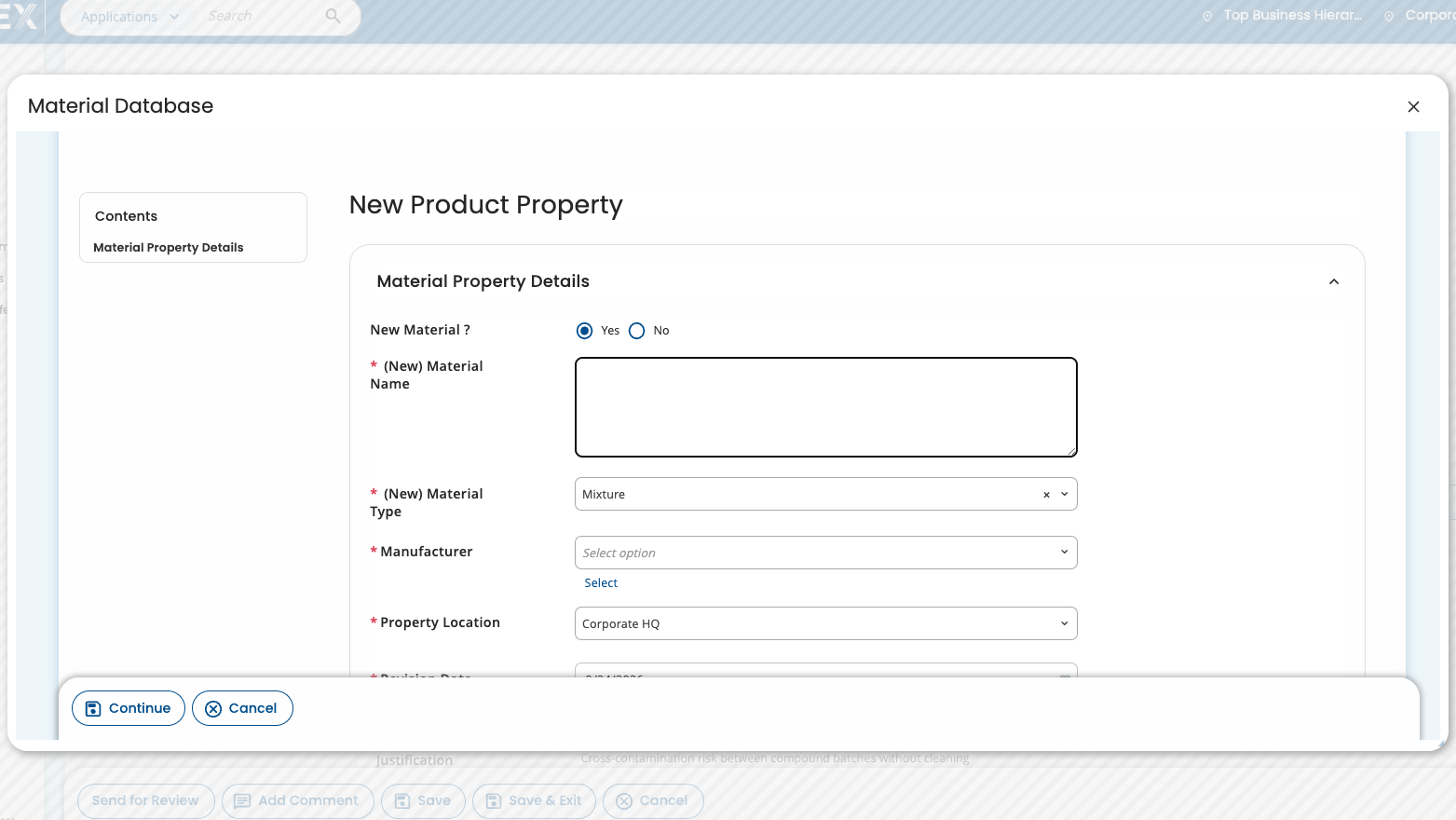
Every decision, even denials, is recorded permanently. This rejection record prevents the same chemical from being requested again and gives you documented proof if regulators ever asks.
Results you’ll see:
- Near-zero unapproved chemicals on site: Approval gate stops non-compliant substances before anyone orders them.
- Approval cycles cut from days to hours: Automated routing and pre-populated hazard data replace email chains.
- Location-specific control: A chemical approved at one site can be refused at another under the same policy.
- A complete, time-stamped audit trail: Capture the requester, site, intended use, date, and approver on every decision.
Replace hazardous or restricted chemicals with safer alternatives, fast
When a chemical is restricted at a site or runs out when a crew needs it, work can stop while someone searches for a safe replacement. When this process is manual, it takes time to research an appropriate replacement, and crews will find a workaround and use whatever is available.
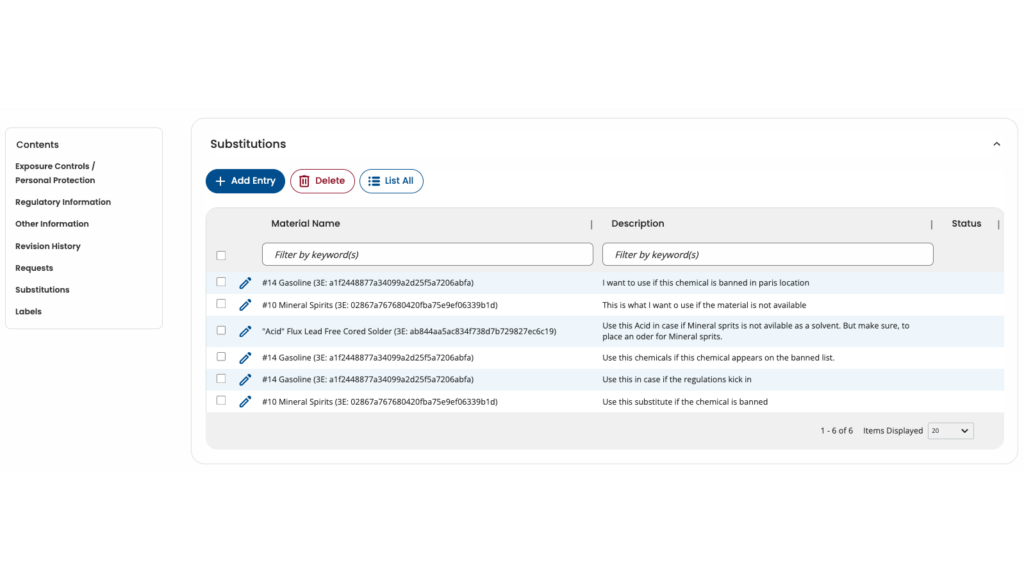
With Intelex, you can define substitutes per chemical ahead of time, and map them to the scenarios that actually occur. For example, when the primary is out of stock or restricted at a given site. Because the alternatives are vetted in advance, the approved option is ready the moment it’s needed instead of after a research cycle.
Results you’ll see:
- Fewer work stoppages: An approved alternative is already defined for common scenarios.
- Fewer unapproved substitutions: Crews see the authorized option first, so they stop improvising.
- Lower chemical spend: Substitution and SKU consolidation reduce direct spend and inventory carrying costs.
Generate and print labels on demand, OSHA format or create your own
Labeling is often overlooked in the chemical lifecycle. Without a clear process, labels are either skipped or written by hand. This approach creates serious risk: An unlabeled spray bottle, a storage closet with illegible handwriting, a secondary container with a label that doesn’t match the current SDS. These risks can compromise worker safety and lead to an inspection finding or citation.
With Intelex, you have the flexibility to generate and print labels based on your site’s needs. Use OSHA’s recommended format or create custom labels to manage multiple types for the same material: primary container, secondary container, general information, storage room, or closet. Choose the format, save a PDF for digital use, or print copies. Each label includes a QR code that links straight to the current SDS, so anyone handling the container can access safety information right away.
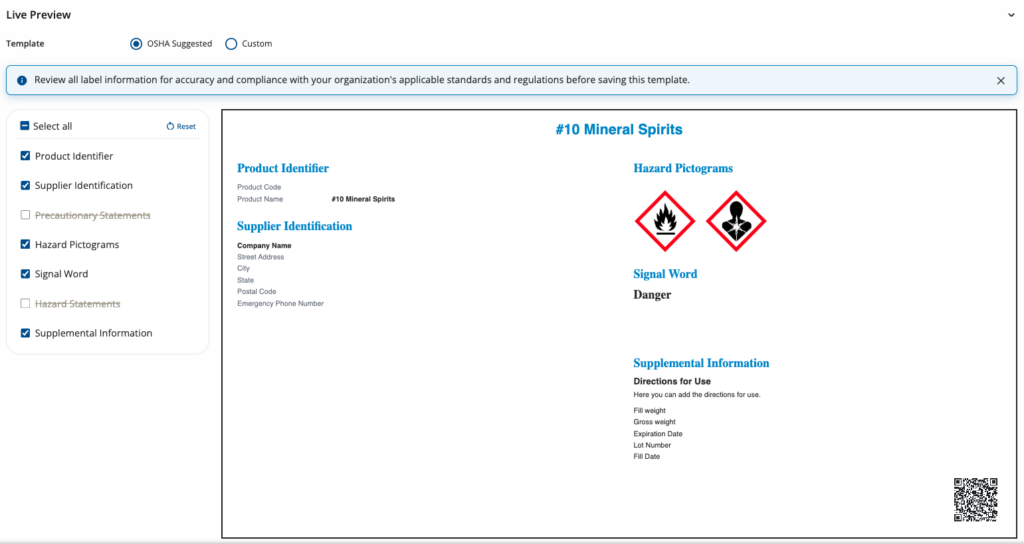
Because you print from the same system that holds your approvals and SDSs, the label always reflects the approved chemical and related documentation, so every container is correctly identified and compliant.
Results you’ll see:
- Better labeling hygiene: Every container, primary or secondary, stays correctly identified and audit-ready.
- Instant SDS access at the container: A QR code links straight to the current safety data sheet.
- No supplier dependency: You produce labels in-house, on demand, in the OSHA-suggested format.
Prove compliance the moment a regulator, insurer, or auditor asks
When a regulator, insurer, or certifying body asks for your documentation, you need the right SDS version for the right chemical at the right site. Usually, this means searching shared drives, binders, and emails, with no simple way to check if every document is up to date.
SDS management is often treated like a static library. There are no alerts when a supplier updates a document, no version history to track changes by date, and no way to see the correct SDS for a chemical at each location.
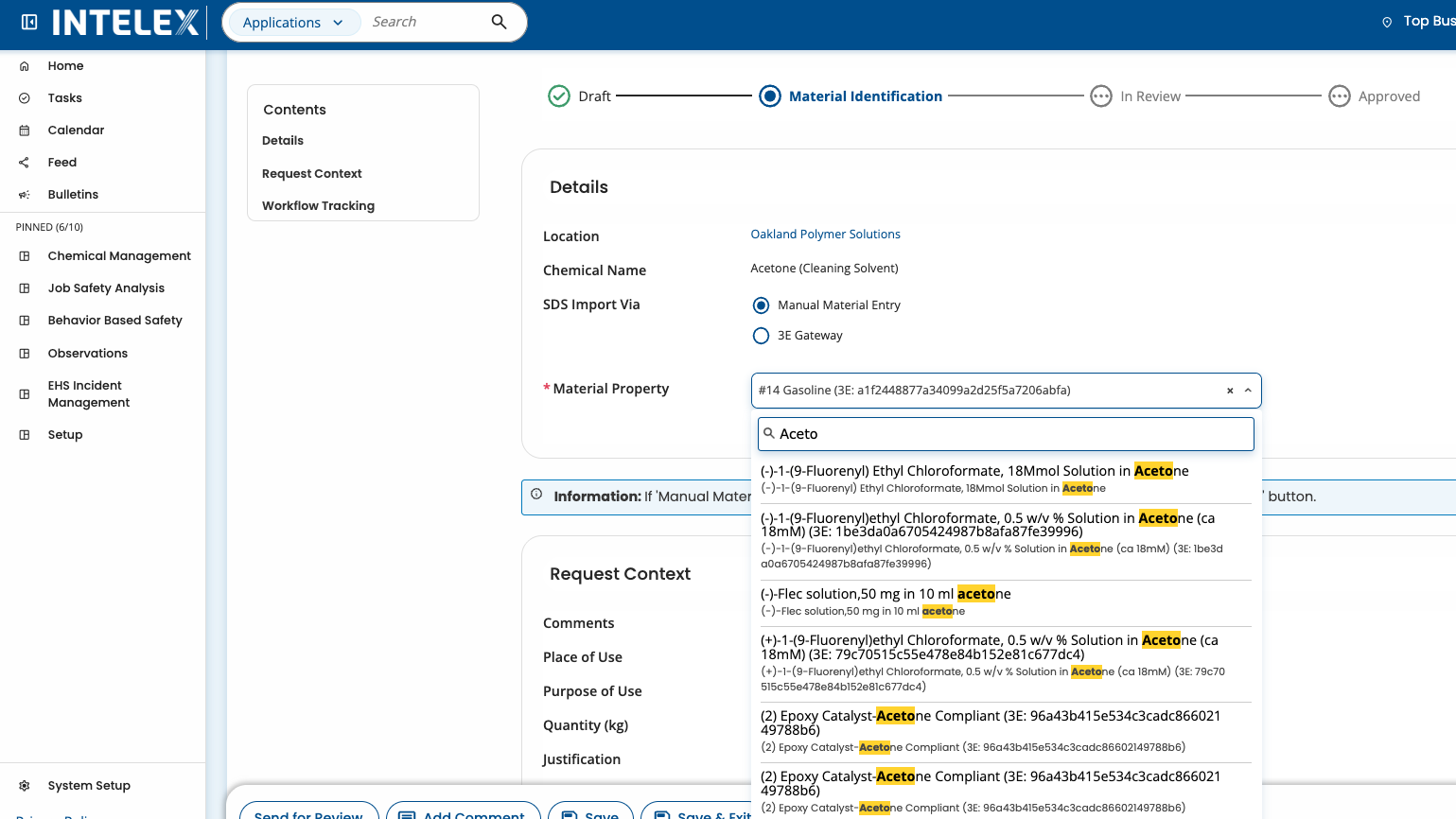
With Intelex, you have a live, version-controlled SDS catalog that flags updates, keeps a full version history, and displays the correct SDS for each chemical by location. When you add a chemical, you can pull it straight from the integrated 3E catalog, which auto-populates the SDS so you don’t have to key it in by hand. Every catalog entry links to its SDS, and a consistent structure across sites keeps everything in one catalog you can work from.
Results you’ll see:
- Current, location-accurate documentation: Update alerts and version control keep the catalog live, and the right SDS shows for each chemical by site.
- Point-in-time proof: Produce the SDS that applied on any past date, on demand, for an audit.
- Less manual entry: The 3E catalog auto-populates SDS data instead of manual key-in.
Ready to close all four gaps in one flow? Book a demo built around your sites.
Making your decision
Managing chemicals on a modern industrial site brings four main challenges, but most tools handle only one well.
- Even a solid SDS library can let unapproved chemicals onto the floor. A good approval form still means you might have to research substitutes manually. A labeling tool may not know what you actually approved, and an inventory system might not track compliance.
That’s why you need all four parts working together.
- A site-level approval gate only works if you have solid substitution options. Substitution is effective only when it’s tied to current SDSs. Labels stay accurate only when they match the approved chemical and the right document.
Solve one in isolation and the problem shifts elsewhere. But if you address all four in one process, you close the loop: employees are protected, non-compliant substances stay out, approvals use current data, and records are always audit-ready without extra work.
Bring approvals, substitution, labeling, and SDS management into one audit-ready process, now available for EHS teams of all sizes. Book your Chemical Procurement and SDS Management demo today.